
Interview with Nick Hafner, Refined Robotics

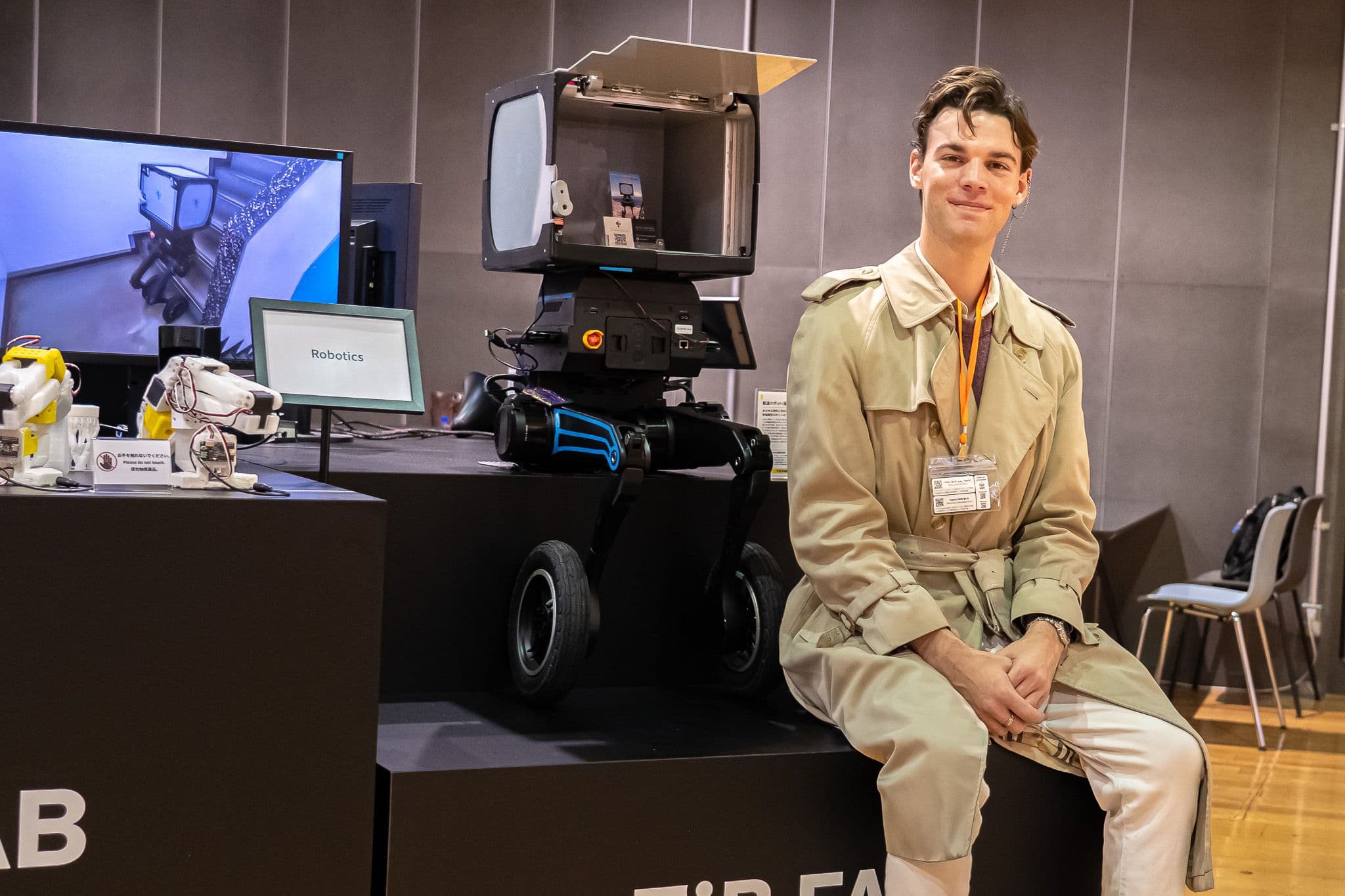
Today we sit down with Nick Hafner, CEO and co-founder of Refined Robotics, to talk about his startup journey in Japan—from academia in Osaka to boots on the ground in Tokyo.
So, thank you for coming. First of all, could you please tell us about yourself?
Sure. I'm Nick. I'm the founder and CEO of Refined Robotics, which is a robotics company spinning out from Osaka, but now based in Tokyo.
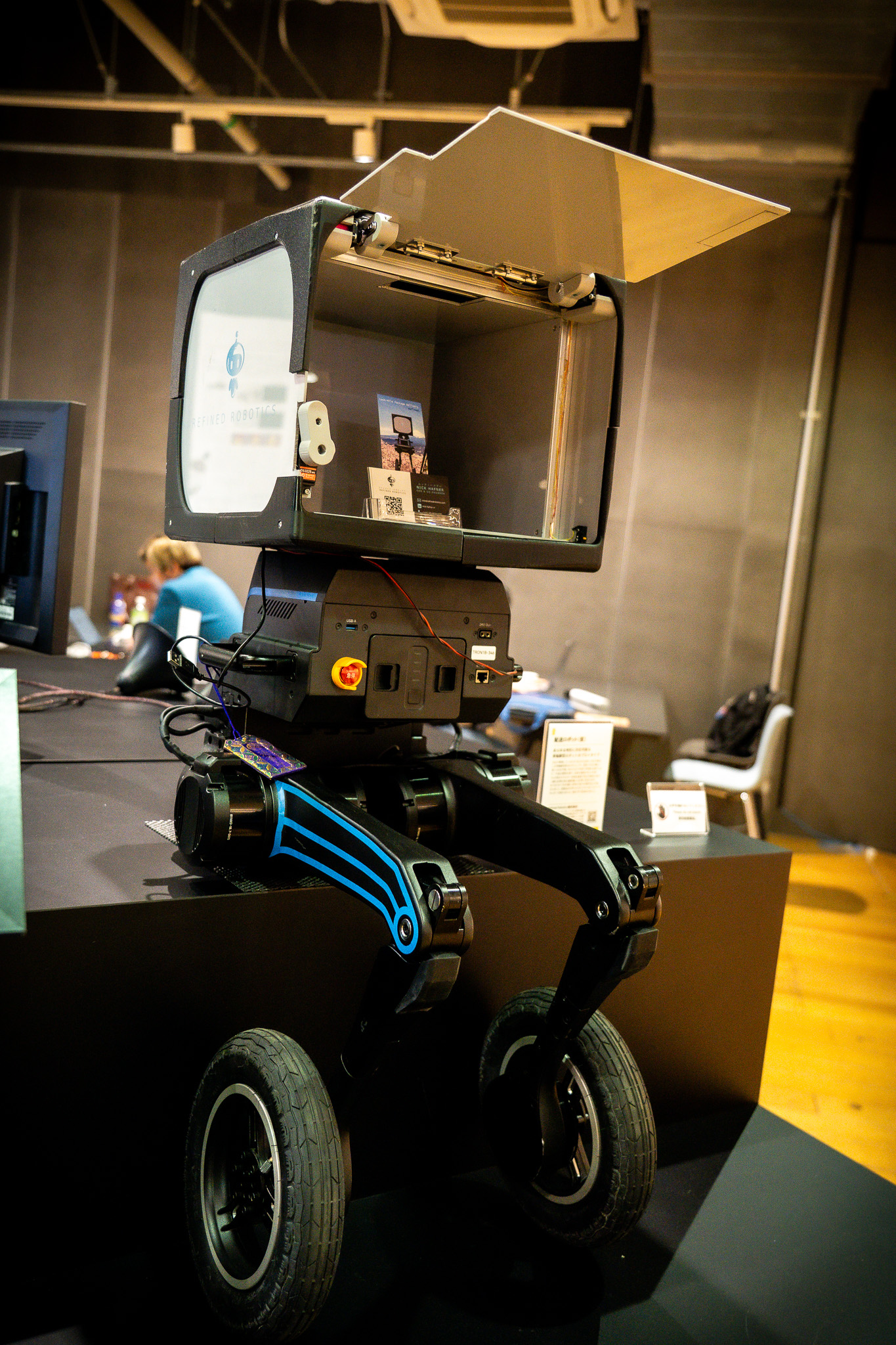
We're building last mile parcel delivery robots that can climb stairs through a unique wheel-legged solution. We have some core technology that increases our energy efficiency up to 25 times, and that means we can take a robot that might have 1 hour of battery life right now, increase its payload, and still give it an 8 to 10 hour battery life which means that's an entire day's worth of work. They can work together with human drivers to improve their efficiency. So if you have one guy driving the van, the three robots get out the back and he can load the robots.

I used to be a PhD student at Osaka University and also doing research collaborations with ATR, which is a lab in Kyoto Prefecture near Nara. I was a PhD student in robotics with Professor Hiroshi Ishiguro, who was one of the organizers of one of the pavilions in the Osaka World Expo this year: super interesting fellow, made some weird robots, made some really cool stuff, and he's kind of a philosopher. He's really exploring how we can define what makes humans human through robotics. Right? If you have a robot that looks exactly like a human, talks like a human, acts like a human, how is it different to a human? And that difference is what makes us human, right?
But sadly, I'm actually much more of a practical roboticist. I prefer solving the problems of tomorrow rather than philosophical questions, and that's why I started a company.
Bit of a weird intro.
No, I loved it. It's sort of coming at the philosophical zombie from the other direction. So how did you end up in Japan?
I was a master's student at Imperial [College, London]. I was also an undergraduate there. And during my final year, I took a course called human-centered robotics by Professor Yiannis Demiris. Amazing guy, super smart. I met him at a conference and he asked me if he was the reason I did a PhD and I told him yes and he apologized. But anyway, I took this course and discovered Professor Ishiguro's work. And I thought he was really exciting and interesting. So I sent him a cold email.
And in the meantime, I got an internship and started working full-time for this robotics company deploying six-legged wind turbine repair robots on offshore wind turbines. I worked there two years and one day Ishiguro replied to my email and we had an interview and he told me to apply for this scholarship, which I got, so then I came to Japan to do the PhD.
I have always been working on various side projects even before the PhD, and my reason for doing the PhD was partly to develop ideas to start a company. That was always my plan. By the end of the third year I was so tired of research that I just went to Tokyo, joined an accelerator program, and went full-time into entrepreneurship. But it was very luckily timed that I had just gotten a patent for my research, and that's what we span out into the company.
You moved from Kansai to Tokyo to launch. How come?
I think the main thing is Kansai doesn't really have an investor network. It is there. There are some. It's very small. So for me, for example, as an Osaka University student, I was able to pitch to Osaka University's venture capital firm, but unfortunately for me, they were in between funds when I pitched to them. And I feel like with Kansai that was kind of it. I mean there are a couple of other firms I did speak for some of them but for me the main thing was not really about that as much as about the community. So Kansai has a really strong manufacturing base. It's great once you're established and your company is five or 10 people and you're ready to just crack on, but it's kind of tough to find people early on.
I did try and get some people from my lab involved but most of them didn't really have any experience yet, unless they were PhD students who already have a few years working for a company before they started a PhD. Most of them are, you know, students who have never worked in the real world and a couple of them were good, a couple of them need a lot of training… and they don't want to take so many risks. Whereas in Tokyo, you have things like Ilya's TAI (Tokyo AI) community, things like Antler Japan's community, things like Plug and Play, Techstars. There's so many different groups both from deep tech and even non-deeptech standard startup groups, which is really exciting. Kansai has a great set of universities for the tech seeds, but they don't really have the next stage when you're trying to find other people to work on it with you. I did attend some business matching, you know, researchers with tech ideas looking for CEO types, but I want to be CEO.
CEO types meant like 50-year-old Japanese men who wanted high salaries and it doesn't really fit the startup stage you're at. You need to already have quite a lot of funding to be able to have these guys which means you kind of already needed a CEO type to begin with, so it feels a bit catch 22. Whereas Tokyo feels not exactly Silicon Valley, but it definitely has the wider range of people of different types who are interested in doing very different things to each other. And then the interweaving of those groups which lets you find very unique and exciting people. And there's a lot more events to bump into people both in Japanese or in English.
What advantages do you think you have as a foreign founder in Japan?
So the first one is that Refined Robotics is not targeting the Japanese market only. So being foreign obviously is a big advantage when you want to go global. Japan has an interesting challenge where—and it's a strange problem to have—the market is big enough that you can become a unicorn without leaving Japan. But if you do that, you are overfit to the Japanese market and you can't leave.
Having the experience of living both in Japan and outside, you have knowledge of both environments and you can make sure to start seeking foreign contacts early.
Secondly, you can break the ice more easily in business. I can do correct keigo [formal Japanese] if I really try, especially with emails, but I think a really good example happened last week. My co-founder, he's Japanese, he was talking with a government body for regulations of autonomous robots in the streets. He CCed me in the emails and I was kind of like watching this email change and they're back and forth with their very polite Japanese to each other and I just replied saying, "hey, actually we're at this event in TIB. Our robots will be on exhibition there. Sorry for being rude, but if you've got some time, do you want to come by?" If I'd been Japanese, I can't say this. Like I wrote it in polite language, right? But I skipped the, "hey, this is Nick from this company, blah blah blah blah blah blah blah blah." And it just got to the point. And the guy replied to me 3 minutes later, that sounds great, and we saw him the next day, and it was a great meeting. Especially in this case because robotics are a physical object, so having that face to face meeting instead of a Zoom call, showing him the robot, letting him touch it, play with it, it's more meaningful.
I think we have leeway culturally. As long as you're respectful about it and you pick the right time to break the rules, that's a strong advantage.
What kind of ideas or plans do you have for international growth?
So the reason I wanted to found a robotics company in Japan.. first off is a little simple: we have the patents in Japan and nowhere else. But in the longer term I still think Japan has a very strong manufacturing industry. When you talk to venture capitalists in the UK and you mention you're doing hardware they kind of get scared, but in Japan they just treat it like everyone else. I think Japanese hardware still has a very strong brand image globally, so I'm also thinking about that aspect. However, the fundraising environment is harder. I've never had a foreign VC ask me for a 5-year financial plan. I'll give it to them if they want, because I had to make it for Japanese VCs!
So basically in the short term, Japan's a great place to develop because labor is cost effective, but it's still very talented. The brand image is good. That's better for mid to longterm. And the food's really nice, so everyone's happier to work hard.

What about the difficulties of doing business here?
As I said, yeah, fundraising is difficult and obviously Japan is in Japanese, right? So, if we focus only on that, our robot will speak great Japanese and be terrible in English and it won't ever get outside of Japan and we'll fall into that bubble I talked about earlier.
It's also been very hard to get corporations in Japan to want to do product trials with us. We have a couple in the works. It's slow moving. It's making progress, but I don't know when it's going to be finished. Meanwhile, I got a contract with a Silicon Valley company in a 15-minute call. Like I chatted with this guy and I said, "hey, you're building this really exciting product. We're building this really exciting product. What if we put them together and we did this thing?" And he goes, "that sounds super cool. When can you come to the States and let's do it?" That was the call. That was it. Done.
So I feel like our way forward is Japan for R&D, as Japan as a market needs the solution I'm building, but US for first trials, Korea/Singapore for early trials, back to Japan for scaling, and then scaling again out of Japan. There's this kind of back and forth flowingness as a foreign founder in Japan. You do a bit outside, you do a bit back here, you do a bit out, you do a bit back here.
What advice would you have for foreign people who are interested in starting a business here?
Learn Japanese! Learn Japanese or get a really good bilingual co-founder.
When I've met with potential clients, they always start with their like one guy who can speak a bit of English because they see that I'm foreign. And I appreciate it. It's really nice. But then the moment I reply in Japanese, it’s like the tension drops. It's like, “ahhhh this guy speaks our language. We can just go straight to business.” And that's really important.
The second thing is to have a reason to develop in Japan. In my field, in robotics, I think that US companies and Chinese companies get funding too easily and therefore they don't focus on actual problems that customers have and they kind of get fat. Which is great in terms of making it easier to start your company, but not so great at forcing you to really think about your idea. Whereas Japan being a sort of intermediate market in terms of difficulty makes sure that you actually really focus on fundamentals, really focus on what the customers want, what the customers say they need.
Of course, everyone in the States will be telling you you need to do the same thing, but when the money comes more easily, you don't need to do it quite as rigorously.