
Japan is moving into Southeast Asia faster than the West, and most brands haven’t noticed yet

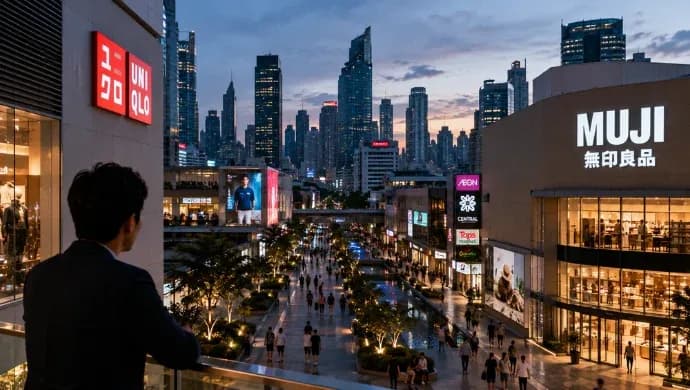
From our Tokyo office, the shift is hard to miss. The Japanese companies we talk to have stopped treating Southeast Asia as a factory floor and started treating it as a customer base. That change in posture is quietly reshaping who competes for the region’s fastest-growing consumers. The Western narrative around Southeast Asia’s growth tends to focus on venture funding, tech unicorns, and the China Plus One supply chain story. That story is real, but it misses the operators already on the ground. Japanese capital and Japanese brands are moving into the region with more speed and less noise than most people expect. If you’re a founder or a marketing lead planning a Southeast Asia play, the competitor you should be studying may not be American. It may be Japanese, and it may already have thirty stores in the country you’re about to enter.
Is Japanese investment into Southeast Asia actually growing?
Yes, and the direction of travel is clear. Japanese outbound foreign direct investment reached JPY32.6 trillion, around US$204 billion, in 2025, its third consecutive year of growth, according to JETRO data cited in the 2026 Japan Outbound Investment Guide. Southeast Asia sits at the centre of where that money is going. The region attracted around US$226 billion in total FDI in 2024, an eight per cent rise, even as global FDI fell 11 per cent, per the ASEAN Investment Report 2025. Japan ranks among the top contributors to that inflow, alongside other major Asian economies. The important detail sits underneath the headline number. Japanese investment used to chase cheaper labor. Now a growing share is chasing consumers, and that is a different kind of competition entirely.
Why are Japanese brands shifting from factories to consumers?
Because the middle class they came to manufacture for has become the middle class they now want to sell to. Vietnam is the clearest case. For decades it was a China Plus One production base, and by 2026 it has become one of the region’s most dynamic consumer markets, according to business advisory firm IGPI. The supply chain shift and the consumer shift are happening at once. China’s share of Japan’s textile imports fell below 50 per cent in 2025, a 31-year low, as Uniqlo suppliers and others moved production to Southeast Asia, Nikkei Asia reported. The same countries making the products are now buying them. This is why the pace matters. A brand that already manufactures in Vietnam understands the market, the logistics, and the consumer far earlier than a brand flying in from outside the region.
Which Japanese brands are leading the consumer push?
Uniqlo and Muji are the two clearest examples, and their store numbers tell the story better than any forecast. Fast Retailing, Uniqlo’s parent, plans to open more than 100 new stores across Vietnam, Indonesia, and the Philippines by 2028, per Feature.Asia. Muji is moving just as decisively. Its Southeast Asia and Oceania revenue rose 28 per cent to 50.1 billion yen, around US$321 million, in the financial year ending August 2025, according to Supply Chain Digital. The brand now runs 39 stores in Thailand alone and recently opened its largest Southeast Asian store, a 3,270 square meter flagship in Bangkok. The list below shows how concrete this expansion has become.
- Uniqlo (Fast Retailing): 100+ new stores planned across Vietnam, Indonesia, Philippines by 2028
- Muji (Ryohin Keikaku): SEA and Oceania revenue up 28 per cent to US$321M; 39 stores in Thailand
- JRE Ventures (JR East CVC): Active investment into Singapore deep-tech and AI startups These are not pilot programs. They are multi-year commitments backed by store leases, local hiring, and product development.
How is this different from how Western brands enter?
Japanese brands tend to localise the product itself, not just the marketing around it. Muji develops local products for each market, from coconut rolls in its Bangkok flagship to region-specific goods across its stores, Nikkei Asia reported. Uniqlo has introduced breathable fabrics for warmer climates like Vietnam and the Philippines. The clearest example is small and telling. Japanese retailers have adapted raincoats for Vietnam’s motorbike-heavy streets, according to UB Speeda’s ASEAN retail analysis. That is a product decision, not a campaign decision, and it signals a deeper read of the market. Western brands often lead with brand storytelling and adapt the product later, if at all. Japanese brands frequently do the reverse. They earn trust through the product first, then let the brand grow from there.
What does this mean for brands competing for the same consumer?
It means the shelf is filling up faster than the market reports suggest. If you are entering Thailand, Vietnam, or Indonesia, you are not entering an open field. You are entering a market where Japanese brands have already built physical presence, local supply chains, and consumer trust. Three practical implications follow for anyone planning a Southeast Asia entry. First, benchmark against Asian competitors, not just Western ones. The brand taking your shelf space in Ho Chi Minh City is more likely to be from Tokyo than from New York or London. Second, respect localization as a product discipline, not a translation exercise. A localised caption will not beat a localized product. The brands winning here are changing what they sell, not only how they talk about it. Third, move on realistic timelines. Japanese brands are playing a patient game measured in years and store counts. A six-month campaign will not out-compete a five-year presence.
Why does the Tokyo vantage point matter here?
Because you see the intent before it shows up in the data. Running an office in Tokyo alongside our Singapore and New York teams, we hear how Japanese companies talk about Southeast Asia in planning conversations, well before a store opens or a funding round closes. The consistent theme is that Southeast Asia is now viewed as a growth engine, a hedge against slower growth at home and in China. That framing changes the level of commitment. A hedge gets funded properly, staffed properly, and given time to work. For brands outside the region, the takeaway is simple. Southeast Asia’s growth story is not a single narrative, and the fastest movers in it right now are often the quietest. Watch Japan closely. It is already several stores ahead.
This article was originally published by our media partner e27.co.