
Physical AI Node Salon #1 event report: building machines in a fragmenting world

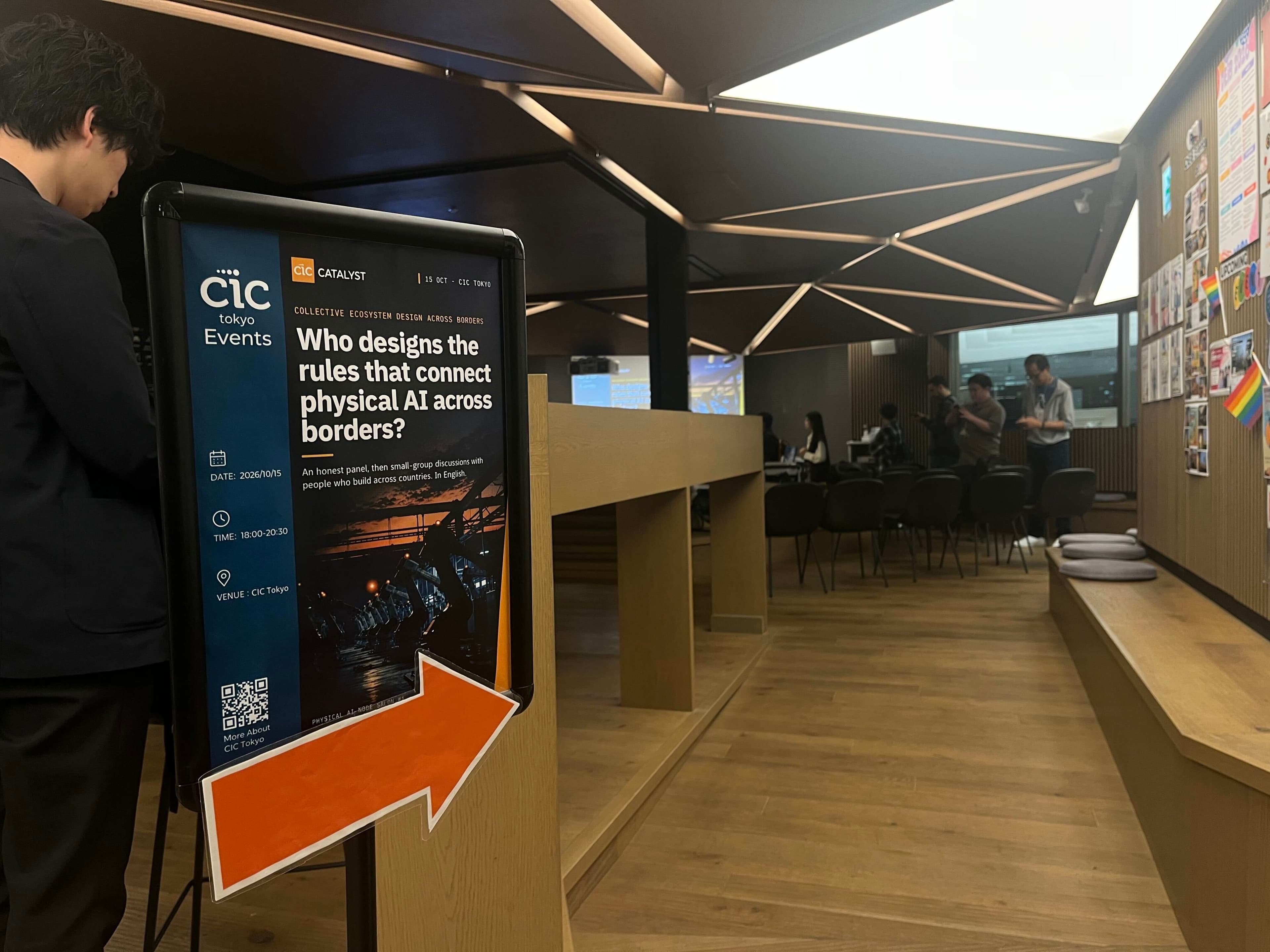
Tokyo has plenty of robotics events, but until now it has had no regular English-language home for the people actually building physical AI. CIC Tokyo is trying to change that with Physical AI Node Salon, a four-part evening series running from October to February. The first session took place on Thursday, October 15 on the 15th floor of Toranomon Hills Business Tower, with a room of founders, investors, engineers and researchers, roughly half of them from outside Japan.
The premise of Session 1, "Collective Ecosystem Design Across Borders," was refreshingly blunt. Physical AI is an interdependent system: the motion data sits in one country, the compute in another, the manufacturing depth in a third and the customers somewhere else again. So the question is not who wins. It is who writes the rules that connect it all, and who ends up as someone else's subcontractor. The organizers promised "no success-story showcase," and the 60-minute panel mostly kept that promise.
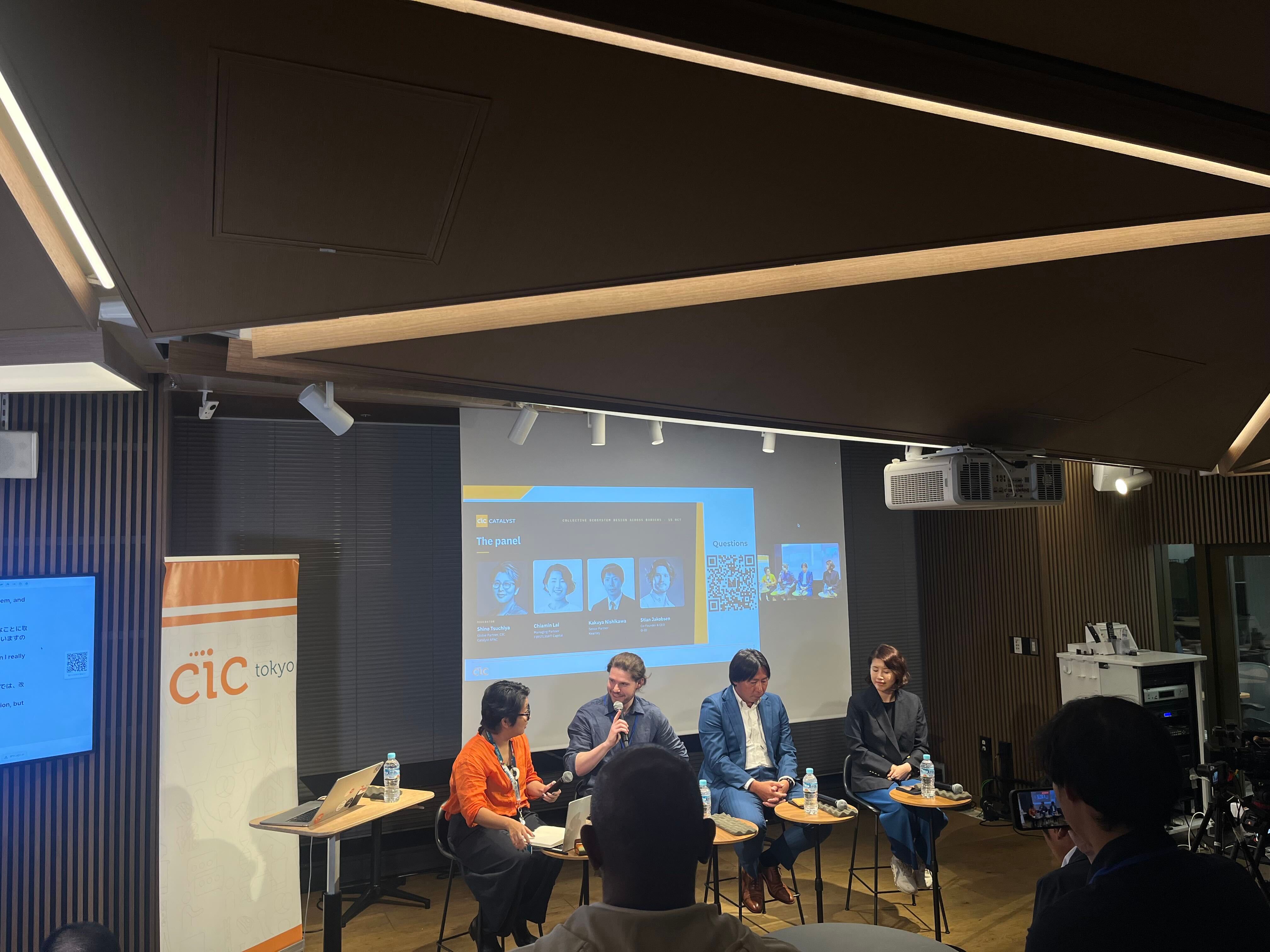
The panel
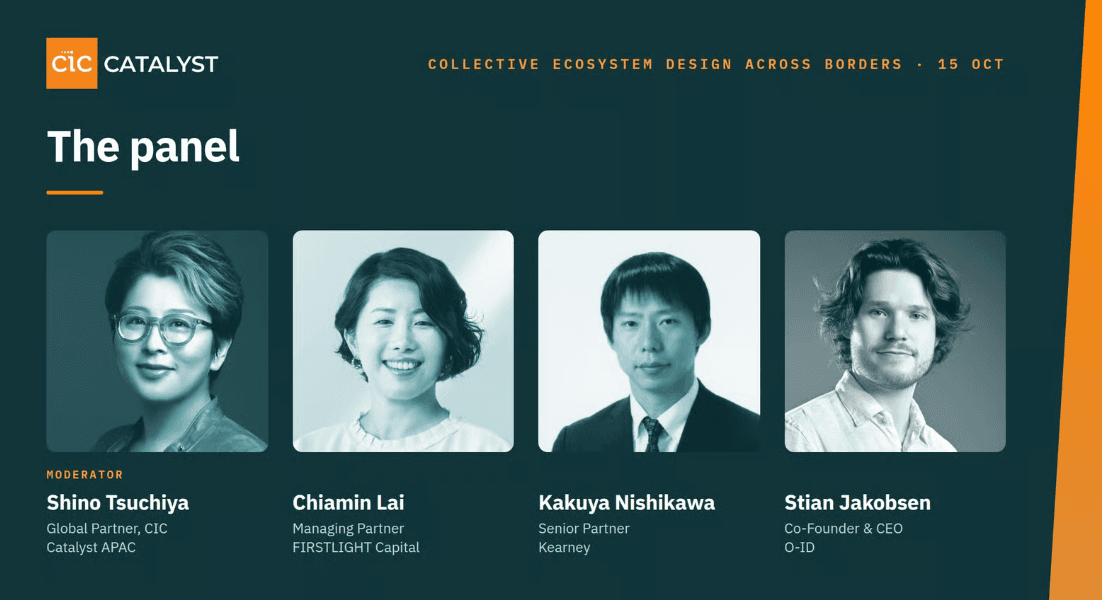
Moderator Shino Tsuchiya-san, Global Partner at CIC (Catalyst APAC), opened by admitting her bias: she believes cross-pollination between ecosystems (Japan and Europe, Japan and the US) is where value ends up being created, and that silos are the biggest obstacle in innovation. With AI, she argued, we are still in the window where the rules are being written. She was joined by three very different vantage points:
- Chiamin Lai-san, Managing Partner at FIRSTLIGHT Capital, a former founder and operator who now invests in enterprise and physical AI aimed at Japan's social problems. She has been writing about physical AI since 2024 and recently published a book introducing the field.
- Kakuya Nishikawa-san, Senior Partner at Kearney, an industrial machinery engineer by training who advises Japanese semiconductor, electronics and heavy industry companies on R&D strategy and overseas expansion.
- Stian Jakobsen-san, Co-Founder and CEO of O-ID, which builds modular humanoid robots in Tokyo with Japanese manufacturers. Originally from Norway, he studied at Waseda and Tokyo Tech, and dates his robotics obsession back to seeing ASIMO as a kid.
Dilemma one: self-reliance or subcontractor?
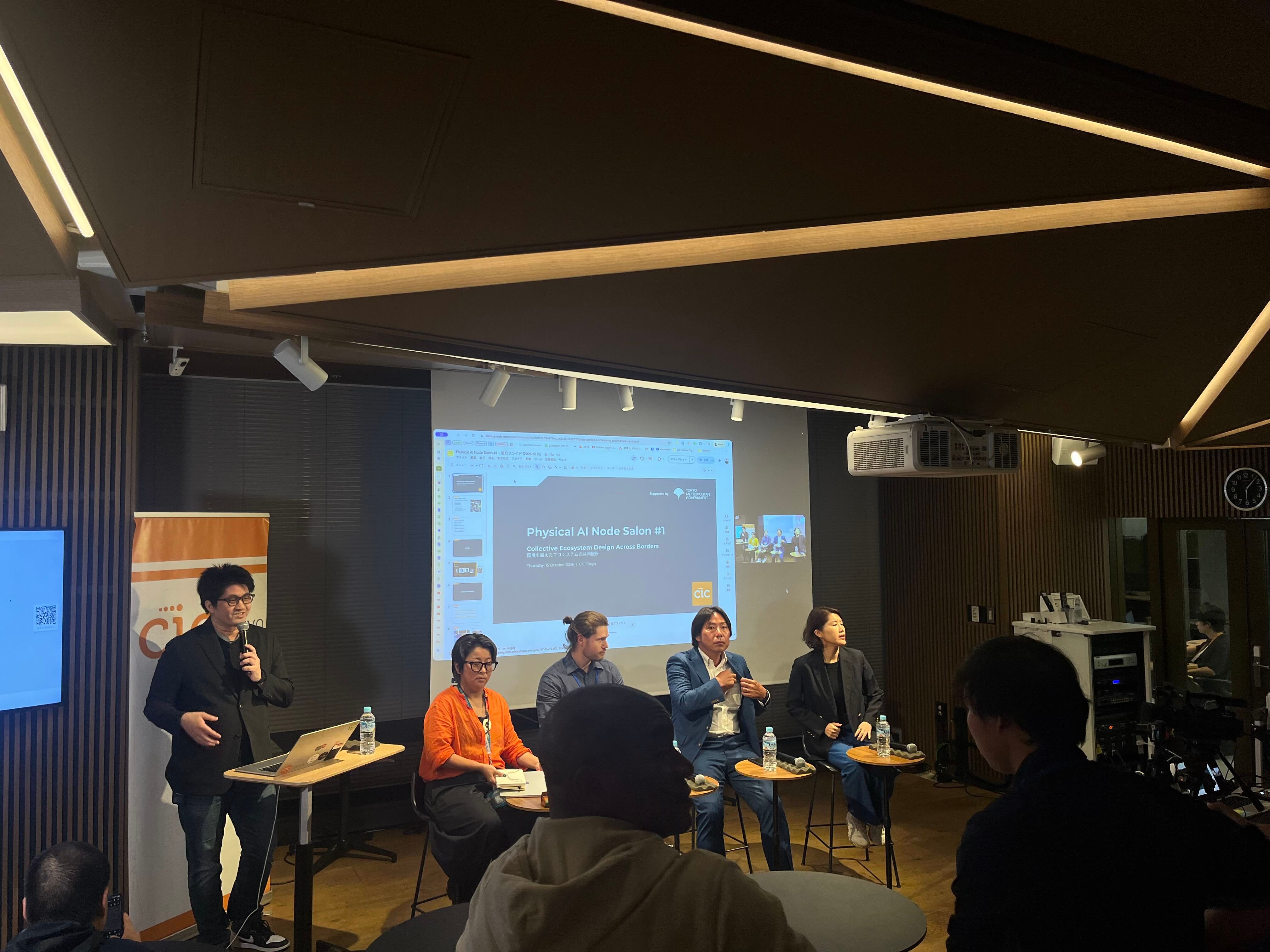
Asked whether the physical AI world is splitting along geographic lines, Chiamin-san's answer was an unhesitating yes, and she expects the split to widen. She broke the field into three layers: data, hardware and the OS, or "brain." On hardware, China has spent two decades building a manufacturing ecosystem deep enough to turn around a prototype in about two weeks. On the OS layer the US still leads, but China is closing in. US restrictions, meanwhile, are already pushing robot parts toward domestic-only supply chains.
Where does that leave Japan? Her honest answer: there is talk of building domestic robotics, and no shortage of startups, but Japan does not have a complete supply chain, and even where the pieces exist, producing at a reasonable price is hard. The opportunity, she argued, is in finding the niches and the missing links between the US and Chinese stacks, and building partnerships that fill those gaps rather than trying to own the whole system.
Stian-san brought a more personal warning from Norway. Not so long ago, Huawei equipment was everywhere in European telecom; then government restrictions arrived and operators had to rip out infrastructure almost overnight. He sees robotics heading down the same road. Who you raise from, whose components you use and which customers you deploy with will matter more and more, especially for government and critical infrastructure buyers. Cheapest will not always win.
The stakes behind all this were framed in macro terms too. If robots can take on physical work that is currently limited by the number of available people, the country that controls that capability gains a real lever on GDP, and potentially on defense. That, the panel suggested, is why the US and China are investing so heavily, and why Japanese CEOs need to stop judging physical AI on today's costs and start judging it on its potential. Carrying on with business as usual in manufacturing and sales, as one panelist put it, simply doesn't add up anymore.
The compute side has its own bottleneck. The constraint on AI software is increasingly power and data centers, and the shortage there is less about land or permits than about people: there are not enough skilled workers to build the facilities.
Nobody agrees on what "physical AI" means
One of the most useful moments came early, when Chiamin-san named what she sees as Japan's biggest problem right now. Thanks to a year of media buzz, everyone is looking for physical AI solutions, but ask ten people for a definition and you get ten answers. Digital twins are physical AI. Sensors are physical AI. AMRs are physical AI.
That isn't just a semantic quibble. As an investor she hears the consequences from founders directly: when a startup and a VC (or a startup and an enterprise buyer) mean different things by the same term, pitches go sideways and expectations never line up. Getting the fundamentals straight, she argued, is a precondition for Japanese startups going global at all.
Dilemma two: 10-year machines, 3-year money
The second half of the panel turned to the mismatch between industrial timelines and venture capital. Stian-san described a funding environment in which much of the capital, concentrated in the US, is flowing into infrastructure plays and mega-rounds. If you aren't an infrastructure or supply chain play, raising big money is hard, and he called that a kind of natural selection that ends up shaping a startup's business and technology strategy. O-ID itself went through micro-pivots and bigger ones, including a move toward the supply chain angle after conversations with manufacturers, much of it driven by investor feedback. Shino-san recalled advising him two years ago that he would need to go to the US; in hindsight, she said, the big wave did end up pushing them that way.
Chiamin-san, speaking as a former founder, laid out the structural problem: a VC fund lives 10 to 12 years at most, and hardware does not fit neatly inside that. She still fields the question "why are you building hardware instead of just software?" from investors who expect a product in six months, and founders end up spending a lot of time explaining the gap.
The slowest clock in the system, though, may be the Japanese customer. A decision that takes six months in China, the US or Europe can take a year and a half to two years in Japan. Large-company deployments may show ROI within roughly two to two and a half years, yet many firms only run PoC after PoC with no visible path to scale. Overseas investors notice. When they look at a Japanese startup, they look at how many customers it really has, and slow enterprise decisions translate directly into weaker funding stories.
Kakuya-san added the corporate view on exits. In his experience, large Japanese companies prefer acquiring overseas companies to domestic startups, partly because they trust their own in-house engineering. He recalled an earlier RFID wave, when Japanese R&D teams looked at outside solutions and concluded "we can build that ourselves," and sees the same reflex in physical AI. For a corporate to buy, it needs a startup with something genuinely new, proven scale beyond Japan and enough conviction to justify the price. Instead, big players are lining up behind partners like NVIDIA, with 47 companies reportedly joining forces to build a robotics foundation model. He also noted, from his own time in a large corporation, that patent filing often happens out of a sense of obligation: one team he knew filed 200 patents in two years across semiconductors, networking and automotive software.
His other observation was about the shape of Japan's robotics industry itself. Almost every Japanese robot company is a hardware company, and much of the market runs through system integrators like Hitachi, built on customized, one-off projects. The industry's challenge is figuring out the next application, beyond collaborative arms, where new technologies like VLMs and VLAs can create value customers will actually pay for.
Case study: same robot, different value
Shino-san then turned to O-ID as a concrete example. The company builds humanoids that can be broken down into modules and swapped out on site. Robots are extremely complex machines, with many joints and actuators, and in the real world something always fails: an arm actuator overheats, a finger snaps. Today that often means pulling the whole machine out for repair. Stian-san's analogy was the car: when you get a flat tire, nobody sends the car back to the factory. You change the tire. Modularity is everywhere in daily life (think USB sticks), he pointed out, so why aren't robot makers doing it?
The most interesting part was how differently customers perceive the same feature:
US investors tend to value modularity in itself, as an architecture and a supply chain story.
Japanese manufacturers care about downtime. If one robot fails and stops a line running 100 robots, the loss can run to millions of dollars depending on how long it's down.
Other customers care most about customization. Once the body is modular, you can start experimenting with custom end effectors and grippers, and configurations that don't mimic a human at all: one arm, three arms, four.
Stian-san also talked about why O-ID thinks of itself as a Japanese company despite its international founding team. It manufactures here, its office is here and its supply chain is here. He sees more automation and robotics startups adopting a similar structure, operating in Japan while tapping US capital, where interest in robotics is large. He also praised the engineering students from Japanese universities who come through the company, and sees a lot of untapped potential there.
Parting advice
Before the room broke into the unconference, each panelist left one message.
Chiamin-san spoke to the enterprise people in the room: if you work at a large company and care about physical AI, help your organization make decisions faster, because that alone would do a lot for the ecosystem. For founders, her practical tip for B2B in Japan was to make sure you have a channel to the real decision-maker through the organization, not just a friendly contact. For those raising, she called now a good window, but advised preparing for what happens next year if expected progress in the US and China doesn't materialize and the bubble starts to wobble.
Kakuya-san described himself, half-jokingly, as a pessimist about innovation who nonetheless loves technology and engineers. After a decade of watching Japanese robotics struggle to sell globally, his interest is less in the technology itself and more in how it turns into money and companies.
The final word went to the founders: don't put all your eggs in one basket. Corporate decisions are slow, a champion can disappear after a management reshuffle, and one client can stall a year of work. Meet as many customers as you can, run them in parallel and treat it as a numbers game.
Why it matters
What made the evening worthwhile was its lack of polish. Instead of announcements, the panel offered the uncomfortable trade-offs that anyone building physical AI from Japan is actually navigating: a supply chain that isn't complete, customers who take two years to decide, investors who expect software timelines, and a geopolitical map being redrawn underneath it all. None of these were solved in 60 minutes, but they were named honestly, in English, in a room that mixed people who rarely end up in the same conversation.
The Physical AI Node Salon has three more evenings at CIC Tokyo between now and February. If you're building, investing in or researching machines that move in Japan, keep an eye on CIC Tokyo's event page for the next session. Registrations are reviewed, so be honest about what you work on.