
Why Japan's Best and Brightest All Want the Same Job

When I was studying abroad, I got used to a certain look on my friends' faces. It was the look people made when I tried to explain how job hunting works for top students in Japan. I'd get halfway through a sentence — "so everyone starts preparing in the spring of their third year, because of summer internships" — and someone would stop me. Wait, why?
I didn't have a good answer at the time. I just knew that's what everyone around me was doing. Only later, once I'd explained it enough times to enough confused people, did I start to understand what was actually strange about it — and, eventually, why it wasn't strange to me at all.
The race after the race
Asia's entrance exam culture is famous for being brutal, and Japan is no exception. You spend years optimizing your life around getting into a good university. Then you get in — and almost immediately, a new race starts.
For the students I knew, the most desirable destinations after graduation weren't tech companies or startups. They were sogo shosha (general trading companies), strategy consulting firms, and foreign investment banks. The hierarchy roughly tracks starting salary. Some students opt out and choose manufacturers or IT companies instead — usually framed, explicitly, as a work-life balance decision, as if that's a separate category from "ambition."
None of this has much to do with what anyone studied. Your major is almost irrelevant. What matters is which door you can get through.

Summer decides winter
Here's the part that made my friends abroad genuinely confused: the calendar.
Everyone starts preparing in spring of their third year — a full year before graduation — because that's when summer internship applications open. And summer internships aren't really internships in the "come learn something" sense. They're the first, and often most important, round of a hiring process that hasn't officially started yet.
Foreign banks and consulting firms move first. If you want in, summer is where you make your case. Companies only have so many slots, and the students who apply early get treated more seriously than the ones who show up later. So everyone applies early. Not because they're told to, but because everyone else is doing it, which makes not doing it feel like falling behind before you've even started.
By winter, the Japanese trading companies and manufacturers open their doors. Some students who didn't land what they wanted in summer spend the intervening months preparing to "win in winter" instead. There's an entire internal vocabulary for this — people talk about "going hard in summer" versus "dominating in winter" the way athletes talk about a season.
What my friends couldn't get their heads around
A few specific details reliably broke people's brains when I explained them:
You start more than a year before you graduate. In most countries, you finish your degree and then look for a job. In Japan, elite students are locked into interviews, tests, and internships while they still have a full year of classes left.
The "new graduate card" only works once. There's a real belief that if you don't land a good job straight out of university, you don't get a second shot — at least not without a permanent asterisk next to your résumé. Job-hopping later in your career is increasingly normal, but that first job still carries outsized weight. This is a big part of why everyone converges on the same handful of employers rather than spreading out based on interest or major.
The personality test comes before anyone meets you. Alongside aptitude exams, most processes include an MBTI-style personality assessment. The results get compiled into a profile of your strengths and weaknesses and sent to the company before a human ever speaks with you. I've heard some versions even generate a probability score related to criminal risk. Nobody questions this. It's just part of the process.
You're hired by the company, not for a job. Almost nobody knows which department they'll end up in, or what they'll actually be doing, until after they've joined. You're not applying for a role — you're applying for membership. The job itself is a mystery you agree to before you've solved it.
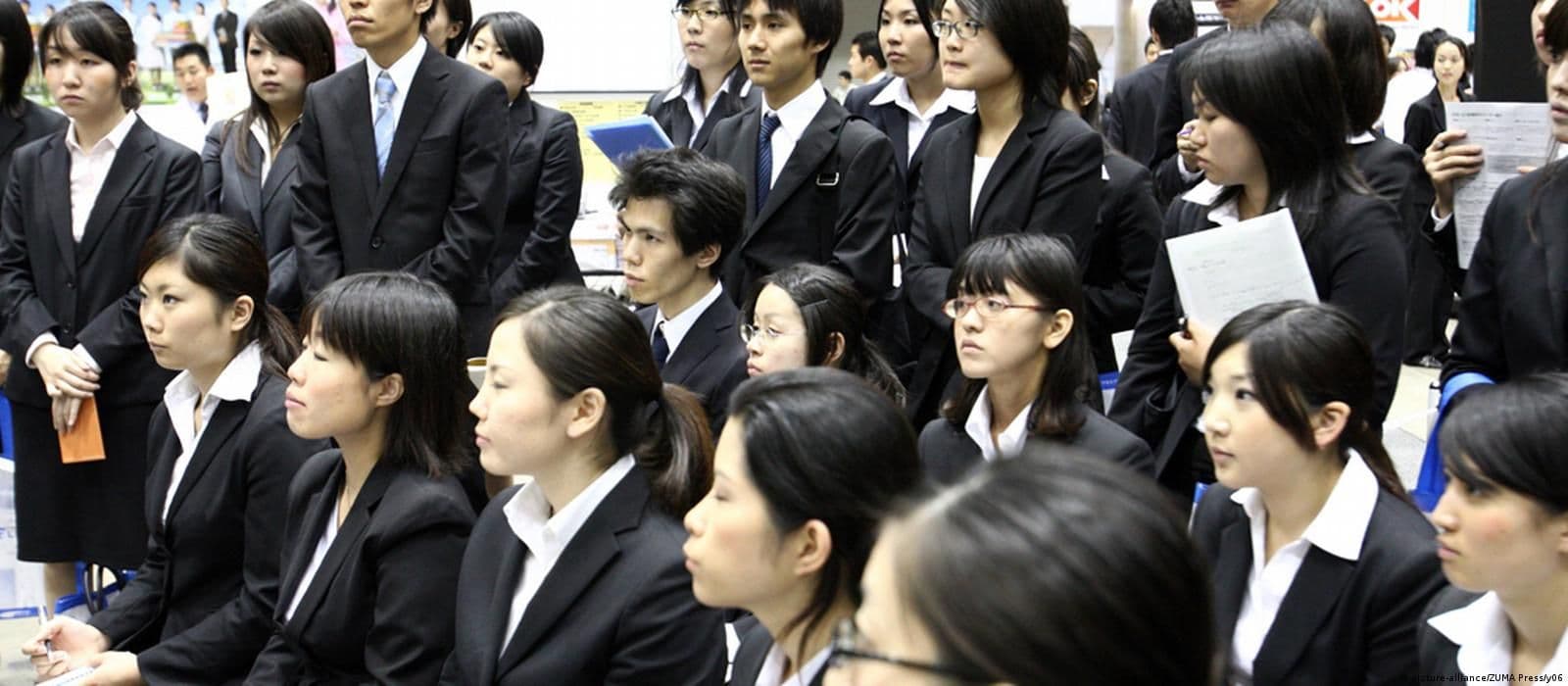
"Dress code: free" means "wear a suit." This one might be my favorite. Occasionally a company will specify that attire is unrestricted — jeans, whatever you want. Almost nobody takes them up on it. Everyone shows up in the same black or navy suit, white shirt, same haircut, as if "free" were a trick question. Freedom, offered, and declined by everyone at once.

The moment it clicked
Explaining all this to friends abroad, I started to notice my own reaction changing. At first I found myself a little defensive, then a little embarrassed, like I was describing something backward. But somewhere in there, I noticed something else: I hadn't actually minded doing any of it.
I didn't have to figure out what to wear. I didn't have to guess when to start. I didn't have to decide, alone, whether I was behind or ahead — I just had to look at what everyone else was doing and match their pace. There's a kind of relief in that. Not having to choose your own path isn't only a loss of freedom. It's also one less decision you have to carry by yourself.
I think that's the part that's genuinely hard to explain to someone raised on the idea that individuality is the goal. Being handed a script, and a thousand other people reciting the same lines at the same time as you, can feel less like conformity and more like company.
Why this is worth writing about at all
Let me be upfront about something: this isn't "how Japanese students job hunt." It's how a narrow slice of top-university students job hunt — the ones aiming for trading companies, consulting, and foreign finance. Most students in Japan are doing something else entirely: attending local job fairs, sitting public-sector exams, staying near home, working to a completely different timeline. Calling any of that "Japanese culture" would be a lie.

But narrowing the lens is exactly what makes this worth looking at. This is the group Japan treats as its most competitive, most sought-after talent — the students with, on paper, the most options. And yet what they actually choose is the same suit, the same calendar, and a company whose job description stays a mystery until after they've signed on. The people most free to choose differently are the ones choosing to look the least different from each other. That's the irony.
I don't think this ends at "individuality gets crushed here." If anything, it's the opposite: not having to choose comes with a real upside. You don't have to decide alone what to wear, when to move, or what to aim for. Follow the people around you, and at least you're never the only one who got it wrong.
I never had a good answer for my friends abroad. But I think I have one now: being free to choose doesn't mean people actually want to choose differently. Some of the most capable people I knew found real comfort in choosing exactly the same thing as everyone else — and that, more than anything else, is the strangest thing I brought back from studying overseas.