
Why Japan's Gacha Machines Keep Selling: A Marketing Breakdown of a ¥196 Billion Market

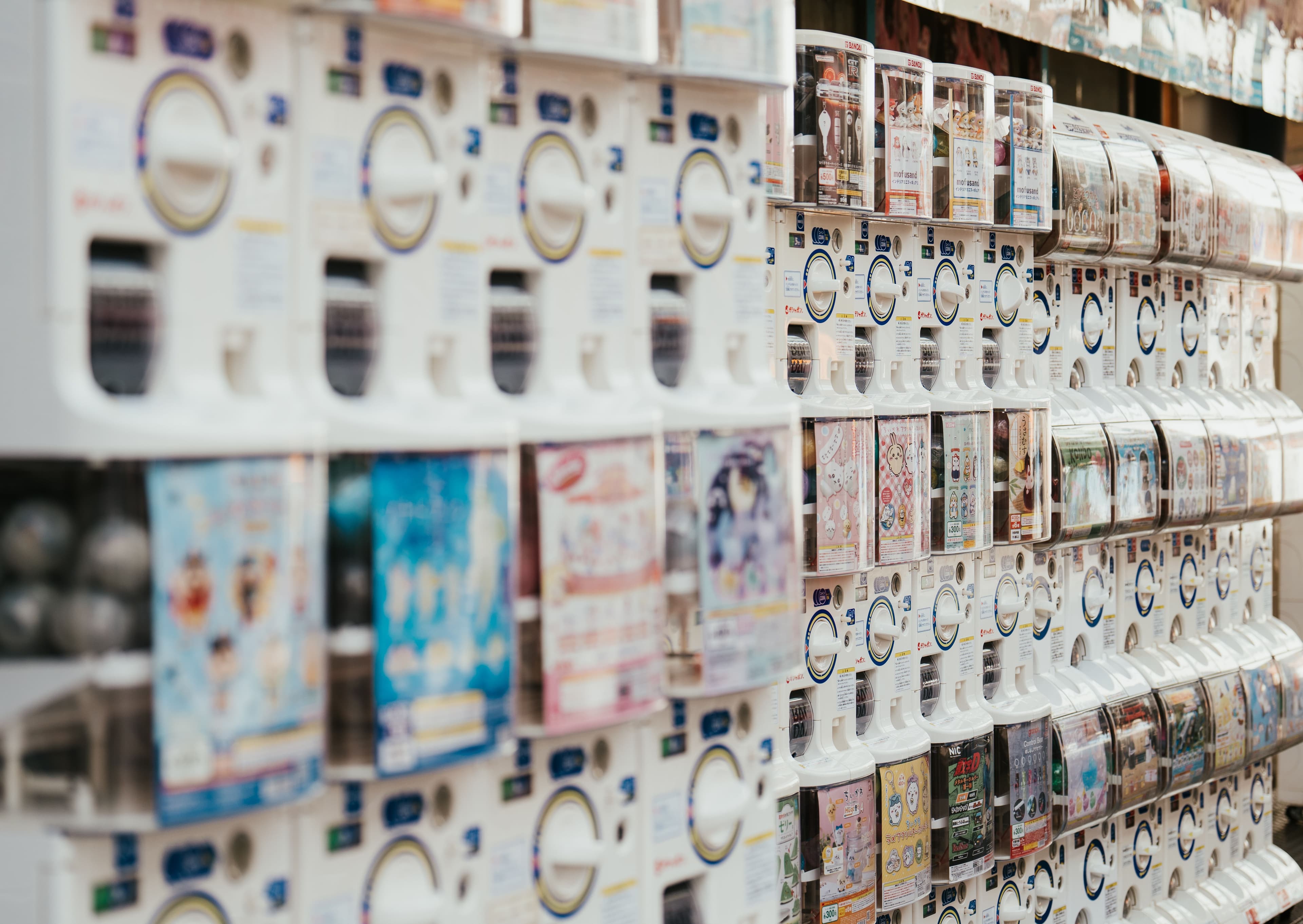
Random-chance capsule toy machines (known as 'gatcha') have become one of the fastest-growing consumer categories in Japan. At a time when inflation has made shoppers cautious, why do toys whose contents you can't even see keep selling, even as prices rise? The answer isn't necessarily gambling-related. It's the consequence of highly rational marketing: a defined target customer, careful pricing, a shift in retail strategy, social-media-era promotion, and a set of conditions unique to the Japanese market, all clicking into place.
Market overview: standout growth in the toy industry
According to the Japan Capsule Toy Association (JCTA), the market reached roughly ¥196 billion in FY2025 on a manufacturer-shipment basis, up 39.0% year on year and a record high. Including event merchandise and corporate-original products outside the survey's scope, the total is estimated to exceed ¥200 billion.
Compare that with the toy market as a whole, which grew 6.3% to a record ¥1.1664 trillion in FY2025, and capsule toys are growing several times faster than the industry average. Converted into units, that's about 550 million capsules a year, or four to five per person in Japan, meaning capsule toys have become an everyday purchase category rather than a passing fad.
The growth rate does need careful reading. Year-to-year figures also reflect an increase in the number of responding manufacturers, so they are not a strict like-for-like comparison. Even so, specialty store expansion, rising unit prices, and a broadening customer base are all moving in the same direction, leaving little doubt that the market itself is expanding.
The macro conditions behind the boom
Capsule toys' success can't be explained by product strength alone. Four shifts specific to the Japanese market created simultaneous tailwinds.
1: Inflation and demand for "small luxuries"
Rising prices usually hurt discretionary spending. But the toy market has polarized: compared with 2019, lower-income households have cut toy purchases the most, and capsule toys' overwhelmingly low price has become a major advantage in this environment. People may hold off on big purchases, but they'll still allow themselves a few hundred yen of fun. Frugality itself is lifting demand.

2: Oshikatsu and the rise of the "kidult"
The oshikatsu (fan-support) boom driving demand for anime and idol merchandise, along with the spread of adult-oriented toys symbolized by the word "kidult," underlies the surge in specialty stores. The shift from a children's pocket-money market to an adult hobby market with real disposable income raised the ceiling on market size.
3: Vacant retail space
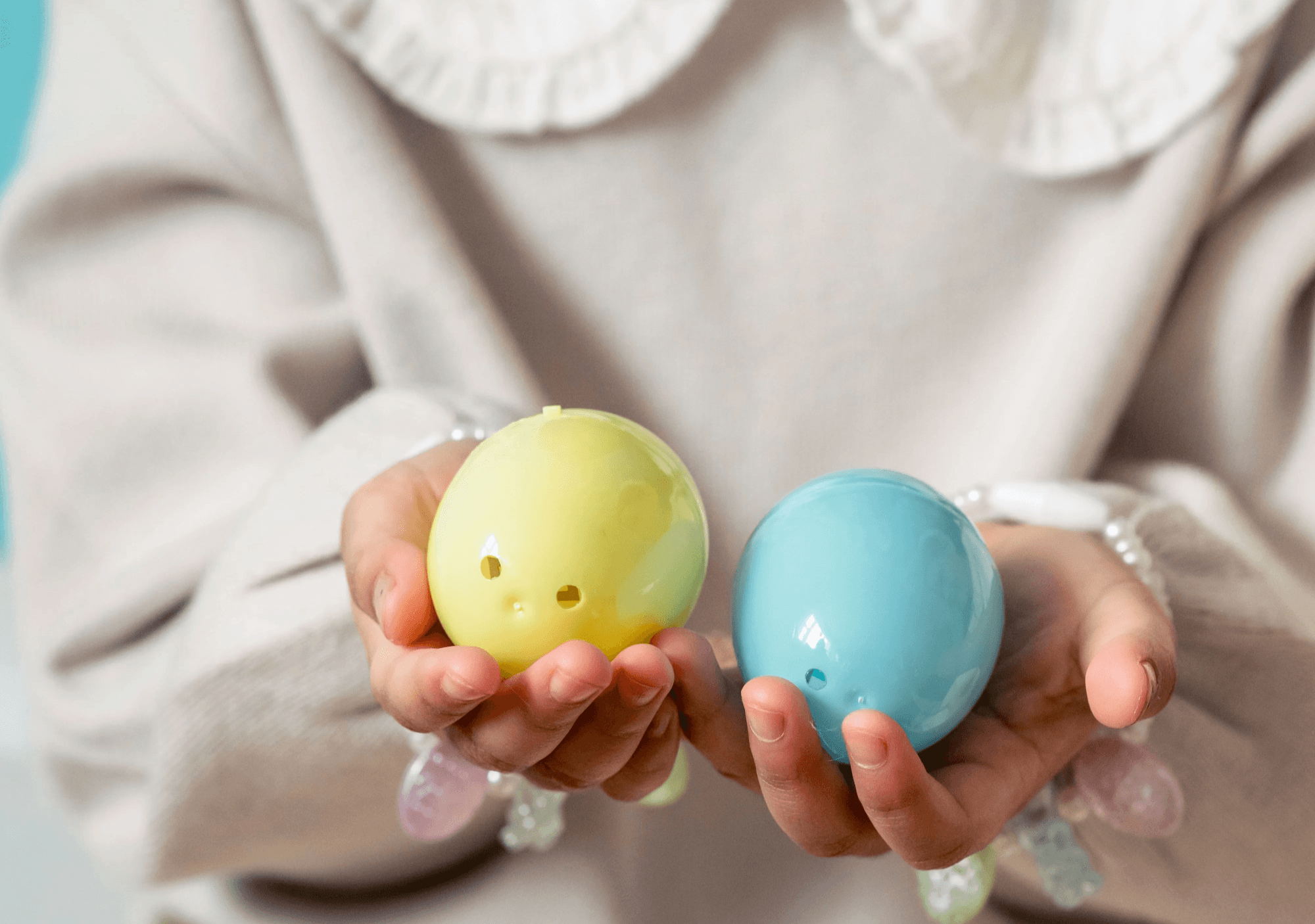
Japan's commercial real estate situation played a big role too. Daily Shincho reported that at a large mall in Saitama, capsule toy machines filled space left by departing fashion tenants, and what initially looked like a stopgap eventually became a permanent fixture with elaborate interiors and signage. Capsule toy stores, which need few staff and almost no power, filled floors emptied by e-commerce and the pandemic.

4: The return of inbound tourism
Foreign visitors matter as well. Tourists once played airport machines to use up leftover coins before flying home, but specialty stores across Japan have now become tourist attractions in their own right. As quirky, easy-to-carry souvenirs of Japan, capsule toys have won an entirely new customer base.

From "children's toy" to "low-cost entertainment for adults"
The biggest marketing shift was redefining the target customer.
The JCTA says women in their 20s and 30s are now the core target, though buyers span all ages and genders. A 2025 Cross Marketing survey found interest highest among people in their 20s and 30s at 45.5% each, with purchase experience at 57.7% for those in their 20s and 63.6% for those in their 30s, far above other age groups.
Positioning changed along with the target. Capsule toys are no longer "cheap toys." They are best understood as low-price, high-frequency entertainment retail, combining IP, specialty stores, inventory search, apps, social media, pricing design, and rapid product turnover. Their real competition isn't other toys but every form of spending that lifts your mood for a few hundred yen: a convenience store dessert, a café coffee, an impulse buy at a variety shop.
The 4Ps behind success
Product: speed of renewal and "no duds" quality
The first feature of the product strategy is the sheer volume of new releases. The JCTA counted 7,357 SKUs released in FY2025. Bandai alone launches more than 1,200 items a year, with some rotating out within one to two months. Despite having no subscription model, the category generates repeat visits because there is always something new on the shelf.
The second is a higher quality floor. Older gacha had obvious duds, but in the adult market, whatever comes out needs to be satisfying on its own. A random sales format that doesn't generate dissatisfaction is what makes price increases possible.
Third, product concepts have diversified: revivals of Heisei-era characters like Sanrio and Tamagotchi, oshikatsu goods, and corporate collaborations that have expanded from food and household goods into cosmetics and apparel. Having multiple demand drivers, from IP and nostalgia to real brands and humor, reduces dependence on any single trend.

Price: a design that makes price hikes acceptable
Pricing is perhaps the most interesting part of this market. Items at ¥400 and ¥500 now account for 48.1% of products, and ¥200 items have all but disappeared. The market has kept growing even as the weak yen and rising material and labor costs were passed on to consumers.
What makes this possible is a uniquely Japanese unit of price: the ¥500 coin. It is one of the highest-value coins in the world, yet handing over a single coin feels far less painful than breaking a banknote. In consumers' mental accounting, gacha spending falls under "small change" or "entertainment" rather than living expenses, making it less likely to be cut.
Higher price points also expanded what products can be. In the era of ¥100 items, size and quality were limited, but today larger capsules are possible and the product range has broadened. Price increases became not just a cost pass-through but a way to raise product value.

Place: from filling empty space to becoming a destination
The shift in distribution is arguably the single biggest growth driver. Specialty capsule toy stores numbered more than 900 nationwide as of January 2026, up by over 200 in a year.
What stands out is the change in location quality. Specialty stores increasingly open in high-traffic, prime spots within malls, a clear departure from the old gap-filling business model built on vacant units. Rulu Ark, which runs the "Gachagacha no Mori" chain, says it moved away from pop-up and event-based sales over concerns about stability and shifted to permanent specialty store tenancies.
Specialty stores had another marketing effect: they removed the embarrassment adults felt turning a handle in front of a toy display. Rows of hundreds of machines turned the visit itself into entertainment and created a space where adults can play openly without needing an excuse.
At the same time, most purchases still happen along everyday routes. Supermarkets, shopping malls, and department stores account for 76.6% of purchase locations, compared with 28.3% for specialty stores. Specialty stores as destinations, and corridors and supermarkets as touchpoints for incidental purchases: this two-tier distribution network handles both acquiring new customers and deepening engagement with fans.
Promotion: building awareness without big ad budgets
Capsule toy promotion doesn't rely on heavy advertising. The products themselves are designed to be the ad.
The iconic example is 2012's "Fuchiko on the Cup," a figure designed not to sit on a shelf but to be hooked on the rim of a cup, photographed, and posted on social media. Small, photogenic, and made to be displayed in groups, product design that naturally generates user-generated content does the work of advertising.
Digital pathways have been built out too. Bandai has added inventory search, photo spots, and loyalty points to its specialty stores, while Happinet's official app offers search, stamps, and coupons. Discover on social media, search in the app, play in store, post again: this loop has turned random impulse buys into purposeful visits.
Capsule toys have even become an advertising medium for other companies. Brands now see capsule toys as an effective ad channel and use them to promote their own products. A promotional item that consumers pay for and carry around voluntarily: few ad formats are this efficient.
Consumer insight: why people spin "just one more time"
The 4Ps work because they rest on an understanding of purchasing psychology.
First, the appeal of uncertainty. A "variable ratio schedule," in which rewards arrive unpredictably, is known to draw people in especially strongly. Random sales, where you can't simply buy the item you want, also increase purchase frequency without raising unit prices.
Second, a minimal sense of loss. Unlike mobile game gacha, capsule toys always leave you with a physical object, which softens the feeling of having wasted money and lowers the barrier to trying again.
Third, the urge to complete a set and the sunk cost effect. Once you've collected half a series, the feeling that stopping now would waste what you've spent kicks in. The fact that people in their 20s and 30s spend an average of ¥1,200 to ¥1,400 in their biggest consecutive-purchase sessions, higher than other generations, suggests this is planned buying aimed at a target item rather than a one-off gamble.
These psychological drivers are universal, but Japan's capsule toy industry is distinctive in commercializing them within limits that don't leave customers with too much regret. Small amounts, a guaranteed physical item, and assured quality: this restraint underpins long-term trust and the market's sustainability.
Industry structure: who makes money, and where
In the capsule toy industry, players win in different ways depending on which layer of the value chain they capture.
The leading manufacturer is Bandai, whose "Gashapon" brand reportedly holds about 60% of the domestic market, with more than 220 million units shipped in FY2024. Its biggest weapons are IP acquisition and product planning.
On the distribution and operations side, Happinet holds about 60% share. It operates around 380,000 machine slots and 137 gashacoco specialty stores. Its capsule toy sales were ¥39.7 billion, accounting for 75.9% of its amusement segment revenue. Its advantage lies not in products but in slot count, logistics, and restocking operations.
Then there are niche makers competing on entirely different terms. Kenelephant targets adult collectors with officially licensed miniatures of real brands, while Kitan Club stands out for humor-driven concepts exemplified by "Fuchiko on the Cup."
This structure reveals asymmetric barriers to entry. Becoming a manufacturer is relatively easy, and the number of makers has grown to around 70. But securing large numbers of machines in good locations and keeping them stocked is far harder. As the market grows, companies that control the retail floor may gain increasing bargaining power.
Blind collectibles are global. Japan's model isn't.
It would be wrong to claim that only Japanese consumers enjoy paying for a surprise. China's Pop Mart proves otherwise. Its 2025 revenue jumped 184.7% to 37.12 billion yuan ($5.4 billion), with overseas revenue up 291.9% to 16.27 billion yuan. The appetite for randomized collectibles clearly travels.
But Pop Mart's model is almost the opposite of Japan's. It is a single, vertically integrated brand selling its own characters at premium prices, with a gross margin of 72.1%, and its Labubu franchise alone accounted for about 38% of total revenue. Japan's capsule toy market, by contrast, works like an open platform: around 70 manufacturers releasing more than 7,357 products a year at a few hundred yen each, sold mostly through simple, unattended machines.
So the real question isn't why Japanese people like gacha. It's why this low-price, unstaffed, multi-maker model thrives in Japan and struggles to exist almost anywhere else. The answer lies in four layers of infrastructure that can't easily be exported, and in the way they depend on one another.

1: Machines that need no staff, no power, and no protection
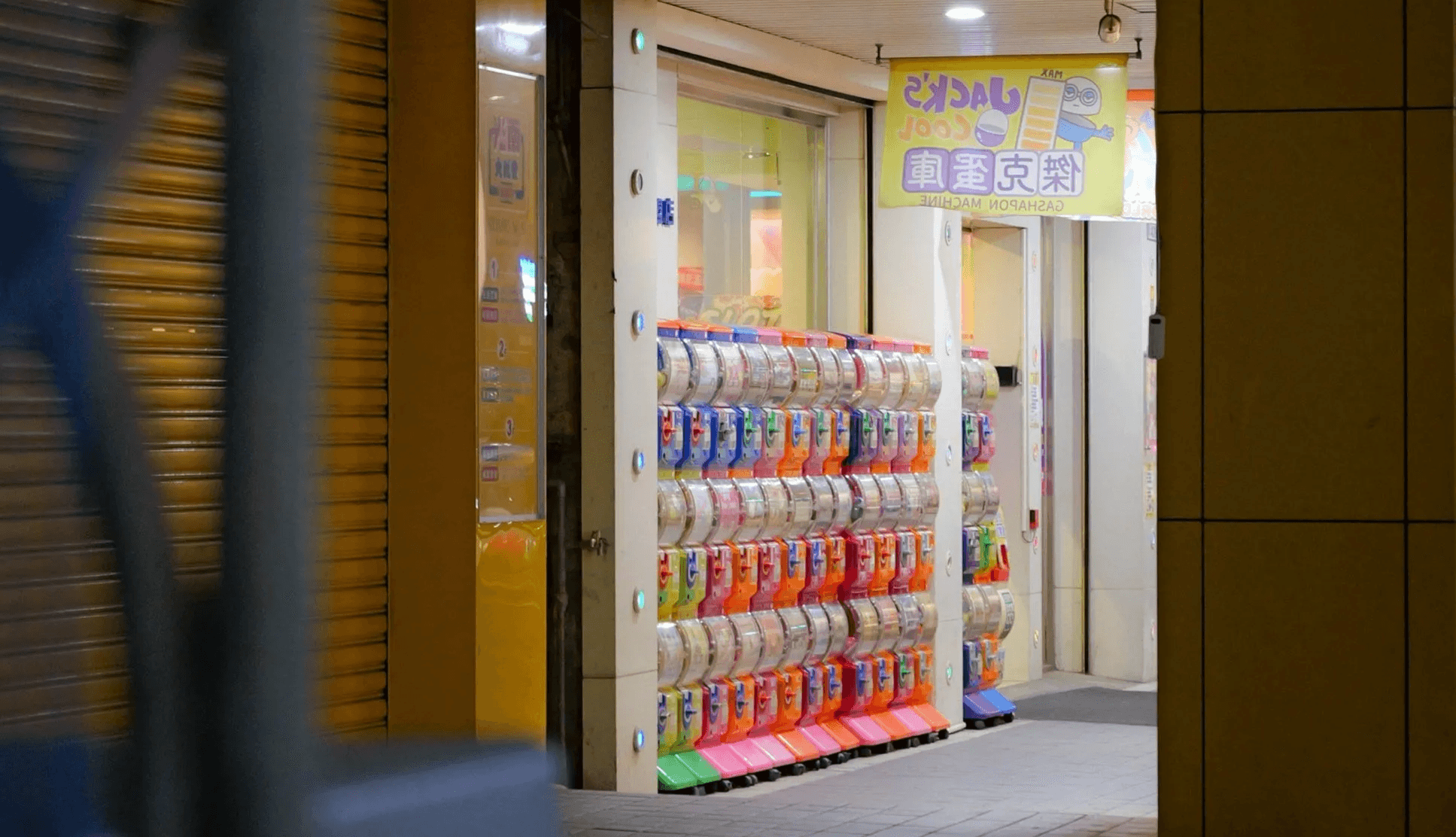
A standard capsule toy machine is a remarkably simple device. It is mechanical: drop in coins, turn the handle, and a capsule falls out. No electricity, no screen, no network connection. That simplicity means machines can be lined up almost anywhere, from the corner of a supermarket corridor to an empty retail unit with no power outlets, at very low cost.
But a machine like this is essentially a box of cash and merchandise left alone in public, and that only works where theft and vandalism are rare. Japan has roughly 3.91 million vending and automated service machines, about one for every 30 people, and an unusually high share of them stand outdoors. In many other countries, vending machines are generally installed indoors to prevent theft.
This is what makes the price point possible. Because machines can run without staff, security, or power, a capsule priced at ¥300 to ¥500 can still turn a profit. Once each location needs a staffed counter and guarded equipment, the economics of a sub-$4 toy fall apart, and the product has to move upmarket. That is exactly where Pop Mart operates.
2: 'One-Coin' Philosophy
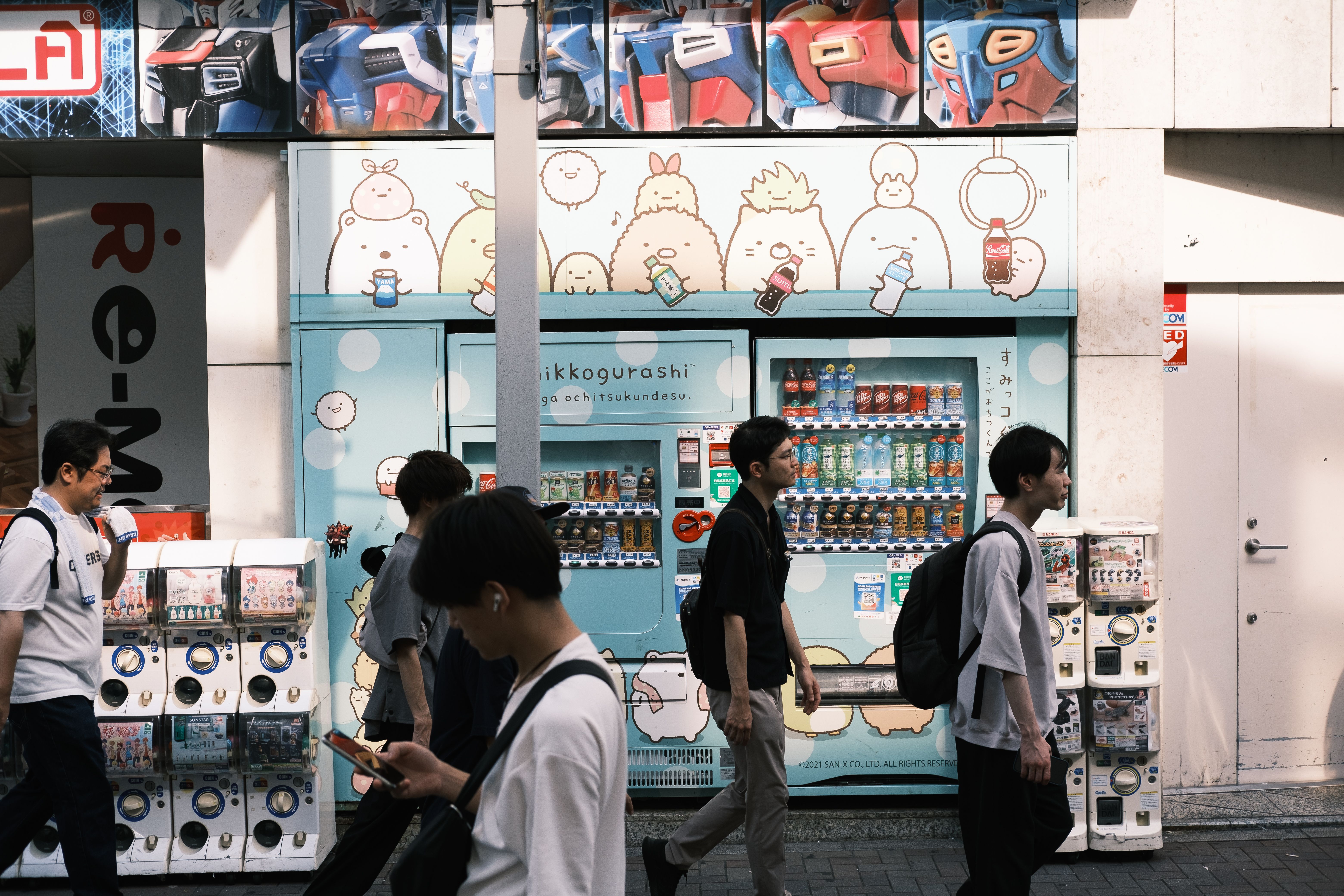
The simplicity of the machine depends on the coin in your pocket. Most capsule toy machines in Japan accept only ¥100 coins. Even Tokyo Disney Resort's capsule toy machines take ¥100 coins only, with change machines installed in the shops. A ¥400 capsule therefore takes four coins, and change machines placed throughout stores let customers break a ¥1,000 note in seconds.
Higher-priced items are the exception. Bandai's Premium Gashapon line requires ¥500 coins, and some specialty stores, such as Gachagacha no Mori, even offer change machines that swap ¥100 coins for ¥500 coins. But these machines reportedly need a power supply for the coin selector, which helps explain why the vast majority of machines remain simple, power-free, ¥100-only devices.
The key point is Japan's ubiquitous ¥100 coin. Most pockets in Japan will have a few ¥100 coins jangling about inside, and it is easy and common to combine. That lets a purely mechanical machine sell a product worth several dollars with just a handful of coins.
Few other markets have this. In the US, the most commonly used coin is the quarter, so a $4 capsule would need 16 of them. Bandai's own US shops work around this by selling tokens, bought with cash or a credit card that carries a $10 minimum. It's a sensible solution, but it adds a step and a counter, and it turns a spontaneous spin into a small, planned transaction.

3: Retail density and a restocking network
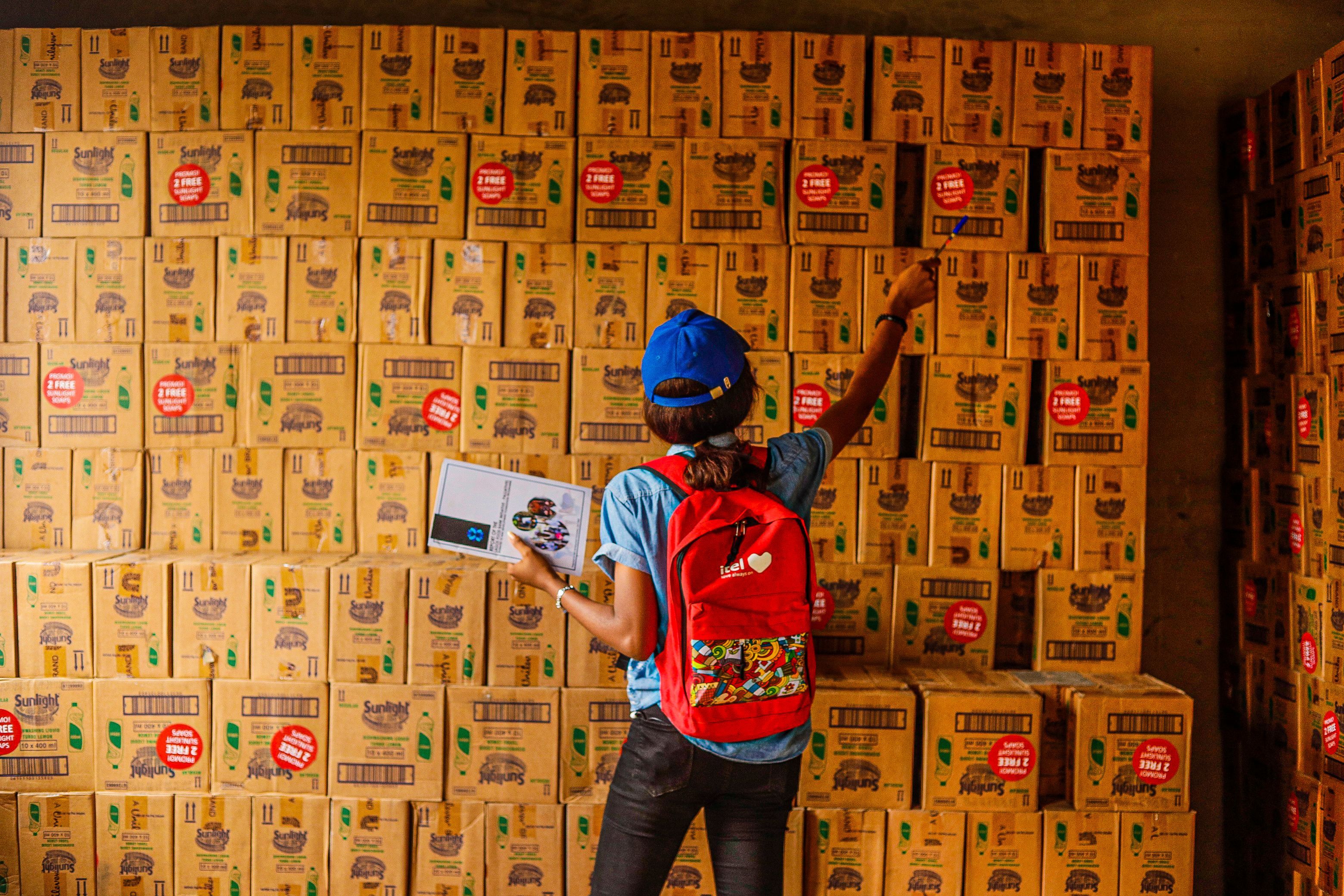
Rapid product turnover only pays off if machines are densely packed and cheap to restock. In Japan, 76.6% of capsule toy purchases happen in supermarkets, shopping malls, and department stores, along routes people already walk every day. Happinet alone operates around 380,000 machine slots, a restocking network that makes one- to two-month product rotations feasible.
In markets where retail is spread out and car-dependent, running the same network would cost far more, and the constant rotation that keeps customers coming back becomes much harder to sustain.
4: An IP ecosystem willing to go small
Thousands of new products a year require thousands of licensing deals. Japan's anime, manga, game, and brand rights holders are accustomed to licensing characters for small, inexpensive merchandise, and the practice even extends to real corporate brands, with collaborations spanning food, household goods, cosmetics, and apparel. Dozens of mid-sized makers can secure rights and move from concept to machine quickly. Without that steady supply of licensed variety, the promise that there's always something new on the shelf would collapse.
Why you can't copy just one piece
What makes the Japanese model hard to replicate isn't any single factor. It's how tightly the factors depend on each other.
Low crime and a high-value coin make simple, power-free, unstaffed machines viable. Those machines keep prices low. Low prices drive high purchase frequency. High frequency justifies constant new releases. Constant releases require a large pool of makers and licensed IP. And that variety keeps dense, everyday locations worth restocking. Remove any one link, whether safety, coins, density, or IP supply, and the whole loop slows down.
The overseas numbers reflect this. Bandai's Gashapon Bandai Official Shop has grown to more than 110 stores across 18 countries and regions. At home, by comparison, specialty stores alone number over 900, on top of hundreds of thousands of machines placed in everyday retail. Bandai itself acknowledges that capsule toy culture isn't as established overseas, which means expansion comes with education costs and challenges in cultural adoption.
What can travel, and what can't
Japan can export the parts of the business that live in the product: IP, design quality, and the specialty-store concept. What it can't easily export is the infrastructure underneath: public trust in unattended machines, a coin that lets a mechanical box sell a several-dollar product, dense everyday retail, and an IP licensing ecosystem built for small merchandise.
That's why capsule toys abroad tend to look like staffed boutiques with tokens and higher prices, closer to Pop Mart than to the wall of machines outside a Japanese supermarket. The toys can go global. The system that turns them into a daily habit costing a few ¥100 coins remains, for now, distinctly Japanese.
From growth market to mature market
 Market expansion also means fiercer competition. Around 700 new products reportedly launched every month in FY2024, and as product counts rise, the odds of any one becoming a hit fall while competition for shelf space intensifies.
The JCTA itself predicted that while market size would keep growing, deteriorating profitability would begin pushing some specialty stores to withdraw, marking a shift from expansion to maturity. Saturation and heavier competition have already been noted in urban areas, especially around the Tokyo metropolitan region.
On top of this, rising costs from the weak yen and labor will eventually hit the limits of what can be passed on through prices. The environmental impact of plastic products could also become a major issue depending on regulation and shifting consumer attitudes. Going forward, winners will be decided not by store count but by same-store productivity, use of data, differentiated products, and experiences that make customers want to come back.
What a tiny product reveals about Japanese marketing
Japan's capsule toys didn't succeed by leaning on the old trick of randomness. The industry redefined its target from children to adults, designed pricing around the ¥500 coin to make increases palatable, evolved its distribution from vacant units into prime-location specialty stores, and turned products themselves into advertising on social media. All of this meshed with conditions particular to the Japanese market: inflation, oshikatsu, vacant retail space, and inbound tourism.
For startups and brands, the lessons are clear. Even at low price points, update frequency and experience design can drive repeat business. Preserve the element of chance while making things easier to find, and impulse buys become purposeful purchases. And the retail floor is not just a place to sell but can be one of the most powerful media channels there is.
Inside a capsule costing a few hundred yen lies a compressed picture of how Japanese consumption and retail work.
References
Japan Capsule Toy Association, "FY2024 Capsule Toy Market Survey" and "FY2025 Capsule Toy Market Survey" / Japan Toy Association, "FY2025 Japanese Toy Market Size" / KACHI CASE, "Why Capsule Toys Captivate Adults: A Growth Industry Read Through Retail, IP and Data" (note, June 2026) / Sompo Institute Plus, "The Expanding Capsule Toy Market" (May 2026) / Cross Marketing, "Capsule Toy Survey (2025)" / Daily Shincho, "Vacant Mall and Shopping Street Units Are Now All Capsule Toys" (July 2026) / Business Journal, "Why Are Capsule Toy Stores Multiplying? The Strategy Behind Gachagacha no Mori's Sixfold Sales Growth" (January 2024) / Business Insider Japan, JOES Magazine, Animation Business Journal