
Newsletter Signup
Join Our Community!
Stay updated with the latest news, exclusive insights, and more.
Stay updated with the latest news, exclusive insights, and more.
To see how we may use your information, take a look at our privacy policy.

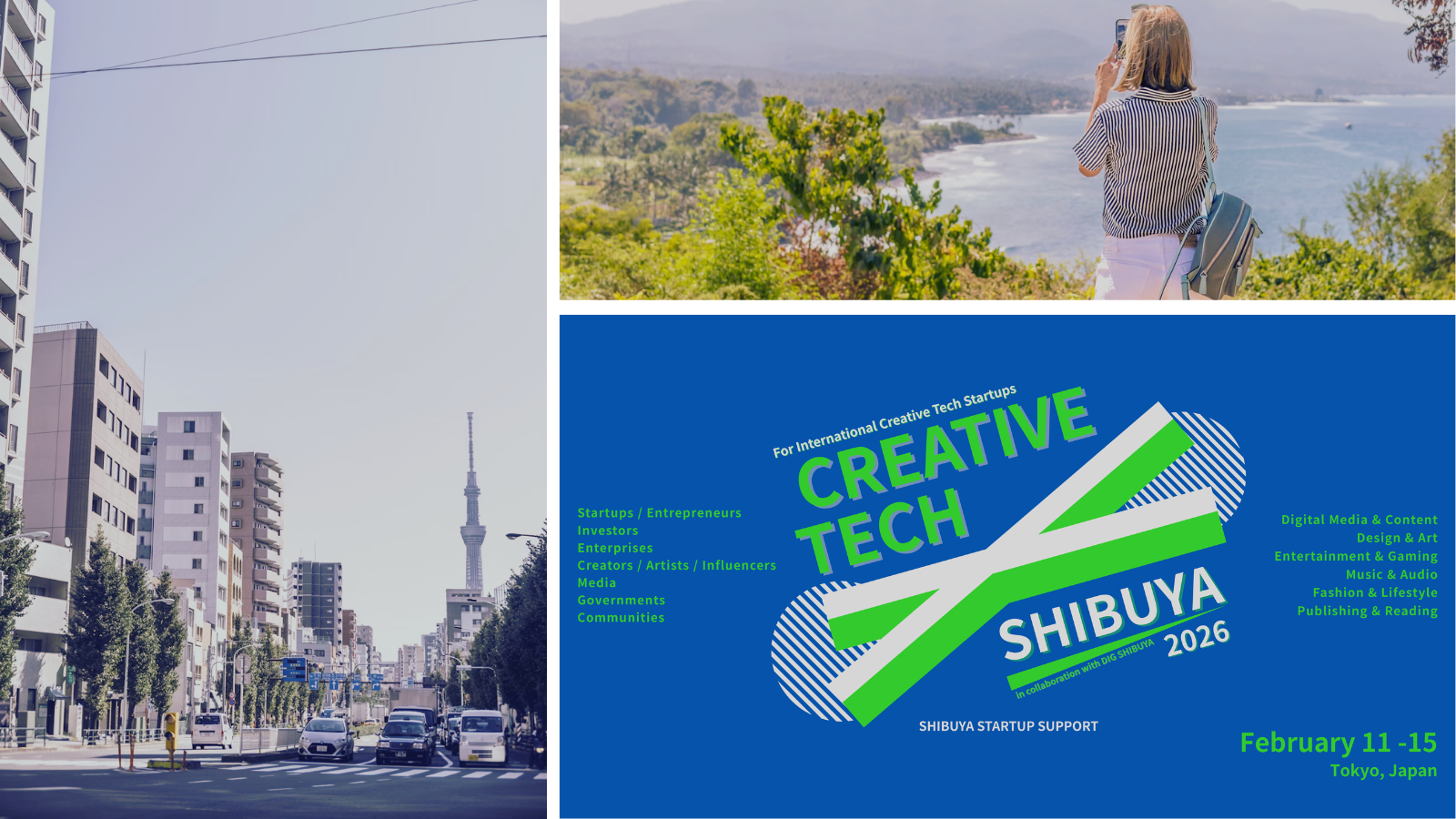
Shibuya Startup Support—an initiative by the Shibuya City Office to support international founders on their startup journey here in Japan—launched the five-day residency program Creative Tech Shibuya 2026 in collaboration with DIG SHIBUYA in February.
The program was designed for overseas creative tech startups seriously looking to enter the Japanese market, with the goal of helping them connect with local companies and raise funding from investors.
While this was the third year of the Creative Tech Shibuya event, it marked a major step forward from the previous one-day event format to a residency program. Ten startups from the United States, Canada, the United Kingdom, Germany, Luxembourg, and South Korea, as well as startups already based in Japan, joined the program.
In this article, the author who planned and ran the program shares insights learned from the experience.
.png)
Shibuya has one of the most active local governments in Japan when it comes to supporting startups, both domestic and international.
Beyond the residency program featured in this article, Shibuya runs a range of other initiatives including networking events for founders, as well as VC office hours.
Shibuya also provides guidance on startup visa program, helping applicants for smooth soft landing.
Building on its support success, Shibuya launched Creative Tech Shibuya in February 2026; its first-ever residency program for foreign entrepreneurs.
The program invited ten overseas creativetech startups that were seriously considering entering the Japanese market to collaborate with DIG SHIBUYA, an art and technology festival run by Shibuya City. The partnership created an opportunity for local companies and people to experience cutting-edge technology from overseas startups.
The residency program was designed to help overseas startups enter the Japanese market, build partnerships with local companies, and connect with venture capital. It covered six industry categories:
Despite a short application term, the response exceeded expectations. It reflected a strong level of interest in Japan's entertainment and creative industries.
After a thorough screening process, ten startups were selected, all of which were seriously considering entering the Japanese market and had already demonstrated some level of traction.
%20(1).png)
Happaning (UK)
An AI-powered video platform turning real-world moments into shared immersive experiences. It connects fans with live events, music, and sports in entirely new ways.
Darewalk (South Korea)
A next-generation SaaS automating ad creation and creator marketing with generative AI. Built to help both brands and creators scale efficiently.
Inkjourney (Luxembourg)
A creative and publishing platform unifying writing, reading, and distribution. It expands the possibilities of story IPs and narrative universes.
Renraku Dynamics (Canada)
Developing AI companions capable of natural, human-like conversations. Focused on enhancing wellbeing and customer experience in tourism and healthcare.
Black Flow Reality (USA / Japan)
A studio blending XR and AI to create multimodal experience-driven media. From gaming and social experiences to healthcare, the team is exploring new forms of immersive experience design.
Couzin Films (Canada)
An immersive storytelling studio pushing the boundaries of documentary filmmaking. Presenting TRACES, a location-based VR documentary experience.
Shisa.AI (Japan)
A next-generation AI startup building open-source, Japanese-specialized LLMs. Bridging cutting-edge technology with deep insight into the Japanese market.
PHONT (Germany)
A European creative-tech startup reimagining subtitles as a visual storytelling layer. Using AI, PHONT analyzes speech, tone, and emotion and translates them into expressive, dynamic captions—more like manga-style visual cues than static text.
REALDRAW (South Korea)
An AI- and 3D-powered platform reinventing Webtoon and visual story production. Designed for the next era of digital comics.
Brainspoke (USA)
A mental wellness technology company supporting stress and anxiety management. Combining innovation with a human-centered approach to well-being.
%20(1).png)
The five-day program schedule was shaped through ongoing discussion and came together as follows.
Overall, feedback from participating startups was overwhelmingly positive.
The involvement of well-established Japanese companies with significant influence in the domestic and global culture and entertainment space created a real sense of momentum, with early signs pointing toward potential partnerships, pilot projects, and investment opportunities.
In the light of the changes to the Business Manager visa, with its much more stringent requirements, there is a need to evaluate how effectively the current system has produced startups that genuinely contribute to strengthening the international competitiveness of Japanese industry.
Enterprises and local governments responsible for promoting foreign entrepreneurial activity face a key challenge: how to identify, attract, and help grow companies with the potential to strengthen Japan's position in the global economy, ideally into unicorns and beyond. A combination of residency programs like Creative Tech Shibuya 2026 and the startup visa system has the potential to be one of the best entry points for making that happen.
For high-potential overseas entrepreneurs who have already committed to doing business in the Japanese market, visa support and market entry support should be offered as a package. The goal is to create a smooth, end-to-end experience from visa application through to relocation and the start of business operations.
For overseas entrepreneurs who are still in the exploratory phase, it is important to regularly host lighter-touch events such as one-day networking sessions to create accessible entry points into the ecosystem.


.png)
.png)


.png)