
Newsletter Signup
Join Our Community!
Stay updated with the latest news, exclusive insights, and more.
Stay updated with the latest news, exclusive insights, and more.
To see how we may use your information, take a look at our privacy policy.

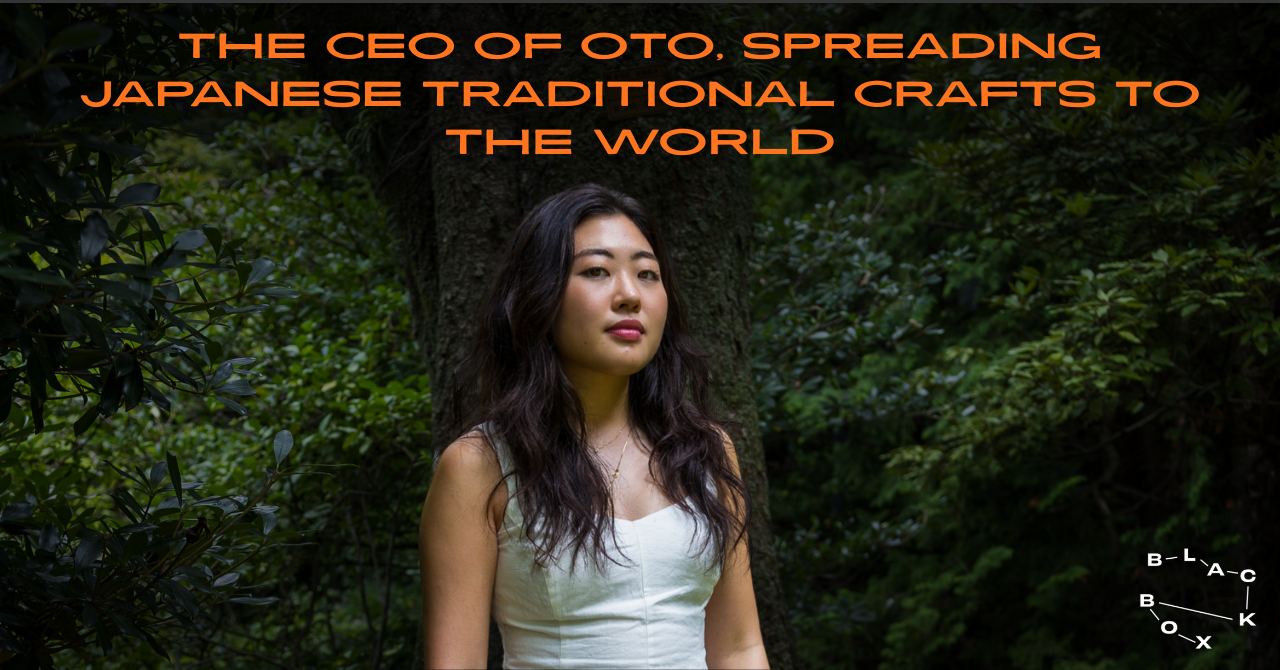
Today, we spoke with Hana Himura, founder of OTO, a creative production studio connecting Japanese traditional crafts with global brands. Hana shares how OTO is creating new opportunities for artisans across Japan, the challenges facing the traditional craft industry, and her journey as an entrepreneur.
I'm Hana, I'm the founder of OTO. Basically, at OTO, we call ourselves producers. If you think about it in a movie sense, there's a director and then there's a producer that brings together all these different moving parts. We're the Japanese crafts producer in that we bring together all of these incredible Japanese craftspeople to realize the vision of our clients. Our clients can range from hospitality like hotel groups to retailers to let's say, fashion brands or architects, and they have a vision on what they want to create and we bring together the right artisans to make their designs come to life.

I'm born in Korea. I'm half Korean, half Japanese and I grew up in Monterrey, Mexico and I spent most of my childhood in Monterrey. I came back 10 years ago and I've been here since. So originally I grew up in this international bubble. I went to an international school in Mexico. I came back 10 years ago. I also went to an international school here. And when I was in this bubble, I kind of rejected my Japanese identity throughout that whole stage. And then I came to this university. Now here I was meeting all of these people and getting in touch with my Japanese side a lot more.
And a key turning point came when I was in fourth year in my seminar class. My friend from that class comes from a 300-year-old Japanese gold leaf manufacturing company. She was the one who kind of introduced me to this world of Japanese traditional crafts. There's so many companies like that in Japan. And she also mentioned that all of these artisans are kind of dying out.
Is there something even a 20-something-year-old can do? So I started calling up all these like different artisans and getting to know them, and that was the start of OTO.
I would say because I don't have a lot of corporate experience, money related topics were one of the hardest for me to grasp. Like, how can I communicate value to the client, that what we do is worth it.
Just figuring out what the right pricing is, and what the right way to communicate our value is so that the clients understand why we're there and why it's worth paying for us. I think it has been the hardest thing so far.
Actually the next phase of OTO is growing and scaling, and right now I'm becoming my own roadblock in that. So right now we're trying to grow a team so that we can actually scale and work with like bigger brands and bigger projects, and we want to be able to support as many artisans as possible throughout Japan. One of our main taglines is there are 1456 traditional crafts in Japan.
I already have one team member, but only two people can’t make this happen. We need a bigger team. We need structure. We need a system to be able to scale.
I think the reason I'm in this business is because I understand the problems. And it's not just the succession issue. It's not just that the industry is gatekept. The whole system is facing challenges: there are fewer apprentices, an aging population, and many structural issues.
At the same time, I think there's also a knowledge gap. Not many people really understand what makes Japanese craftsmanship special. That's one of the reasons I started my Craft Chronicle series on social media—to help people realize that Japan has so many incredible crafts. People know that "Made in Japan" means high quality, but they often don't know why.
What does "Made in Japan" actually mean? It comes from a philosophy—from Shinto values, respect for nature, the use of natural materials, and the importance of handmade production. All of these elements are what make Japanese crafts and monozukuri so unique.

Right now, there are many companies like ours trying to support traditional crafts in different ways. Some collaborate with artisans to create products, while others focus on consulting through design or architecture. I think there's still so much potential that hasn't been realized.
One thing I'm trying to do is build strong case studies with international brands and show that Japanese craftsmanship can become part of people's everyday lives without feeling overly "Japanese" in its aesthetic. I truly believe Japanese craftsmanship, materials, and techniques can naturally fit into anyone's daily life.
One of the key concepts I use is yonobi, which means "beauty in utility." Japanese crafts shine when people actually use them. So the question is: how can we help people use these crafts in their everyday lives, and how can we connect the right brands with the right artisans to make that happen?
If we can increase demand and create sustainable cash flow for workshops across Japan, many of the industry's challenges will begin to change. I know so many creative people who love pottery, embroidery, and traditional crafts. The reason they don't pursue those careers is often because they can't afford to make a living as artisans or apprentices.
If the industry becomes financially sustainable and offers stable incomes, I think many people would choose to work in local workshops, creating ceramics or embroidery for a living. That's the future I hope to see. There are still many steps to get there, but I'm very excited because I believe the potential is enormous.
I think I kind of said earlier, but like, stay curious and always keep learning, and if you want to learn about something, like, reach out. It's okay to always ask. I also struggle with this a lot, but it's okay to just reach out to someone and be like, "Hey, I love what you do. Tell me more about it."
And that's how I started OTO. I just started asking all of these different artisans in the Tokyo area.
Whatever you can do at whatever stage of life, just go to people, be nice, smile, and have a friendly conversation. The easiest way to learn and connect with people is to get to know them.


.jpeg)
.png)


.png)