
Newsletter Signup
Join Our Community!
Stay updated with the latest news, exclusive insights, and more.
Stay updated with the latest news, exclusive insights, and more.
To see how we may use your information, take a look at our privacy policy.

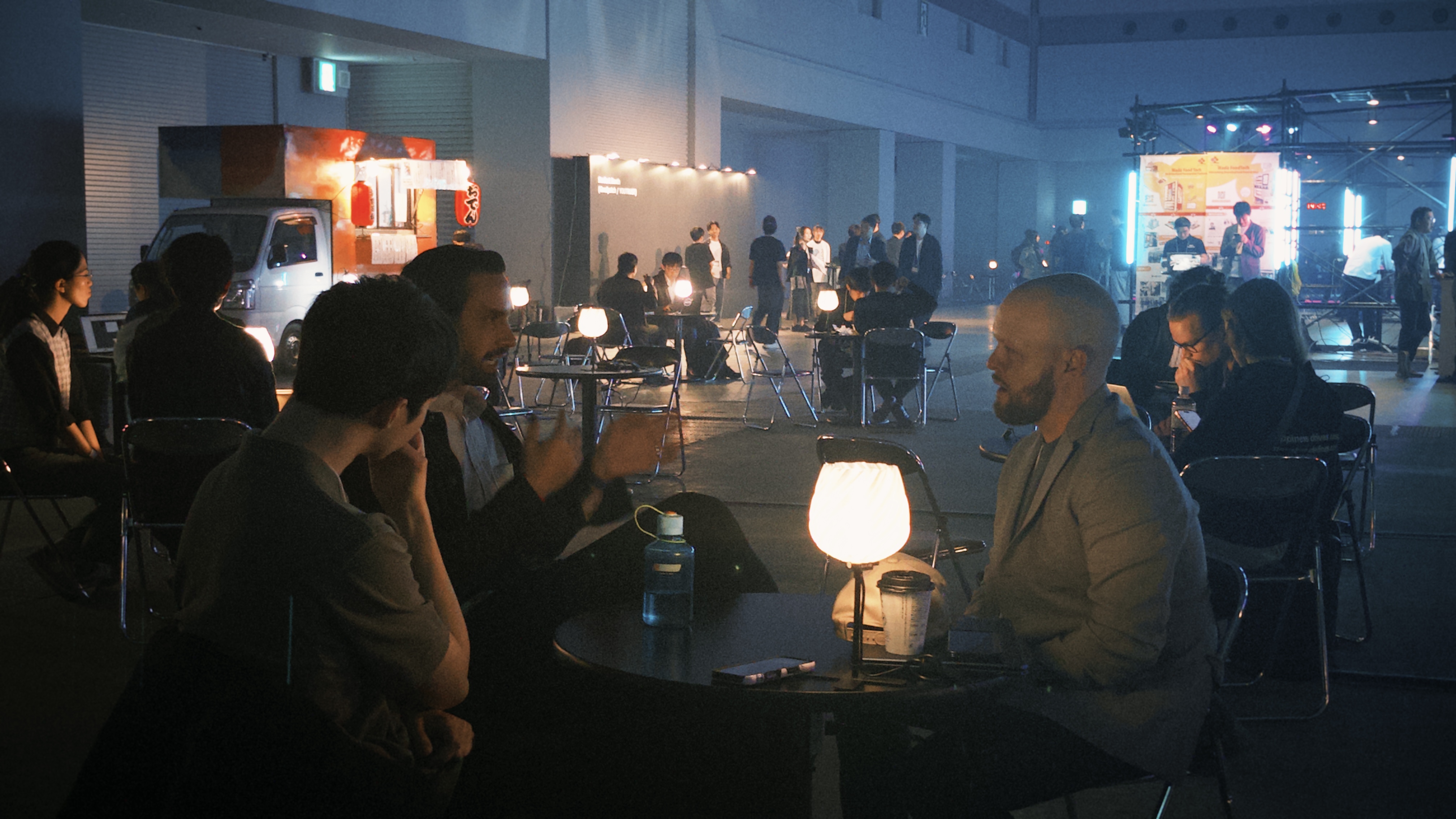
In the South Halls of Tokyo Big Sight on 31st March and 1st April 2026, TAKEOFF TOKYO battened down the hatches as a spring storm raged outside.
The foul weather acted as a filter, leaving behind only the most diehard entrepreneurs and investors to experience organizer [Antti Sonninen’s] latest annual offering. With his dedicated team of nearly 200 operational staff (80% of whom were student volunteers, representing the next generation of entrepreneurs), they brought a level of passion to this international conference that cut right through the heavy atmosphere of the rainy day.
This year's key players showcased a diverse range of ventures, from the bleeding-edge implementation of AI and next-generation robotics, to consumer products such as ice cream.
Throughout the venue, it was common to see reps engaging with potential customers, investors, and even those looking for jobs and internships.
.jpg)
On the Panel Stage, intense discussions regarding the present and future of startups unfolded daily. A major highlight was hearing from Yoshi Yokozawa of Alpaca, who built the first Japanese-led unicorn in the US. His session, The First Japanese Unicorn in the US: Lessons from the Last Decade, provided a raw look into the grueling reality of competing in Silicon Valley.
Other sessions featured VCs and PE funds discussing the difficulties of breaking into the Silicon Valley ecosystem, as well as deep dives into redefining Japan's strengths in IP/culture and deeptech as areas where Japan can lead once again.
While the discussions didn't shy away from the challenges facing domestic startups, the common thread across all sessions was a global perspective, despite being based in Japan, with every speaker was looking decades ahead at the world stage.

The centerpiece of TAKEOFF TOKYO remains its pitch contest. Startups were given just four minutes to distill their vision and business model into a compelling narrative, all competing for the grand prize.
At this year's event, 50 startups entered the fray. After day one, the field was narrowed down to six finalists who took the main stage for the day two finals.
Let’s introduce the finalists who made it to the ultimate stage.

OneInbox offers a human-like AI Voice Agent platform that automates everything from inbound inquiries and outbound sales calls to appointment scheduling for property viewings… all 24/7 and without a single line of code.
In the real estate industry, the speed of phone response directly impacts closing rates. As emphasized during the pitch, "whether or not you can pick up the phone at that exact moment" can determine tens of millions of yen in revenue. However, it is physically impossible for staff to handle every call while they are out showing properties or in meetings, leading to massive missed opportunities.
OneInbox solves this by deploying AI specifically fine-tuned for real estate operations. By learning from property documents, the AI seamlessly handles calls the moment human staff are unavailable. Furthermore, with support for over 70 languages, it ensures that inquiries from international clients are never missed.
As one of the startups backed by Shibuya Startup Support, a key driver of Tokyo’s startup ecosystem, OneInbox is expected to see rapid growth both domestically and internationally due to its high level of practical utility.
.jpg)
VanaM is a South Korean deep-tech startup dedicated to developing next-generation cinema hardware and semiconductor materials centered on its proprietary energy-responsive nano-thin-film technology. Their flagship product is an invisible, ultra-thin heating and sensing film designed specifically to eliminate lens fogging and thermal issues on professional film sets.
In the film and video production industry, sudden temperature changes causing lens fog are a major factor in production delays. VanaM addresses this challenge with the world’s first multifunctional energy-responsive thin film, which integrates both sensing and switching functions into a single layer, allowing it to automatically detect heat on the lens surface and maintain optimal temperatures to prevent fogging.
The company has been recognized as part of the South Korean government’s "Deep Tech Startup 1000" and has also been selected by Luminate, a world-renowned optics and photonics accelerator based in the United States.
.jpg)
Based in Tokyo, Refined Robotics is a high-growth startup developing next-generation last-mile delivery robots capable of climbing stairs and navigating uneven terrain. Utilizing their proprietary wheel-legged technology, the company enables autonomous delivery in complex urban environments, including steep steps and obstacles that were previously inaccessible to traditional wheeled robots.
You can read our interview with them here.
.jpg)
Next up was Zero Grid, led by high school entrepreneur and Gen Z influencer Kotaro Murakami. Leveraging his expertise in social media marketing, Murakami is tackling the "hidden struggle" of the creative industry: the unfair compensation of behind-the-scenes creators.
While the video market is booming, editors and videographers are often stuck with low, fixed-rate fees, missing out on any upside even when a video goes viral. Zero Grid solves this by providing an automated performance-based revenue sharing platform.
By distributing earnings directly to team members based on pre-set ratios and real-time views, Zero Grid transforms creators from contracted help into equity partners. Supported by strategic connections with major ad agencies, this young visionary is setting out to redefine the creator economy.

TAKEOFF TOKYO 2026 was about more than just technology. Aiming to stir the waters of Japanese food culture, the food industry joined the fray with POCO, a high-protein ice cream. The founder, originally from Sweden, stood personally at the booth, engaging passersby with a passionate message.
Upon arriving in Japan, the founder (originally from Sweden) noticed a lack of healthy, convenient food options. Seeing this gap as an opportunity, he developed an ice cream that is both sugar-free and high in protein.
In a venue filled with complex technical explanations, this direct message struck a chord with many.

Led by 20-year-old entrepreneur Sunwoo Park, UNCHAIN provides "ASGUARD," an AI security platform designed to protect AI models from cyberattacks and unpredictable behavior.
As enterprises rush to adopt generative AI, vulnerabilities like prompt injection have become critical risks. ASGUARD transforms security from a barrier into an enabler, ensuring that companies can deploy AI with confidence. It is a vital infrastructure product built for the demands of the modern AI era.
.jpg)
Out of 50-strong field of fierce competition, VanaM emerged as the champion! UNCHAIN was also recognized as a key visionary. Congratulations to both teams for their achievements.
.jpg)
In TAKEOFF TOKYO this year, the diversity was striking—industry boundaries were blurred, and the age range of entrepreneurs was wider than ever. The energy on display was so contagious that the weather outside became completely irrelevant.
A defining characteristic of this year was the ubiquity of AI. It felt as though AI has become the standard foundation for every startup, utilized not just as a buzzword, but as a practical core to drive innovation.
While the feedback from VCs during the pitches was sharp and demanding, it undeniably served as a catalyst for growth, pushing these founders to refine their visions. I am already looking forward to seeing what incredible new startups will emerge to surprise us next year.


%20(1).png)

.png)
.jpg)


.png)